
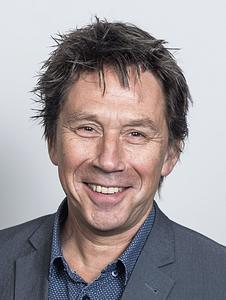
Pierre Dillenbourg
Nationalité: Suisse et Belge
Site web: https://www.epfl.ch/education/phd/
+41 21 693 20 71
EPFL › VPA › VPA-AVP-DLE › AVP-DLE-EDOC › EDLS-ENS
Site web: https://www.epfl.ch/education/phd/
+41 21 693 20 71
EPFL › VPA › VPA-AVP-E › AVP-E › AVP-E-LEARN
Site web: https://learn.epfl.ch
Expertise
Online Education, MOOCs
Human-Computer Interaction
Collaborative learning (CSCL/CSCW)
Eye Tracking
Tangible interfaces
Educational Robotics
Expertise
Online Education, MOOCs
Human-Computer Interaction
Collaborative learning (CSCL/CSCW)
Eye Tracking
Tangible interfaces
Educational Robotics
Ancien instituteur primaire, Pierre Dillenbourg obtient un master en Sciences de l'Education (Université de Mons, Belgique). Dans son projet de master en 1986, il est l'un des premiers au monde à appliquer les méthodes de 'machine learning' à l'éducation, afin de développer un 'self-improving teaching system'. Ceci lui permettra de débuter une thèse de doctorat en informatique
à l'Université de Lancaster (UK) dans le domaine des applications éducatives de l'intelligence artificielle. Il a été Maître d'Enseignement et de Recherche à l'Université de Genève. Il rejoint l'EPFL en 2002, où Il fut le directeur du Centre de Recherche sur l'Apprentissage, la formation et ses technologies(CRAFT), puis du Centre pour l'Education à l'Ere Digitale (CEDE) qui
a notamment mis en oeuvre la stratégie MOOC de l'EPFL (plus de 3 millions d'inscriptions). Il est actuellement professeur ordinaire en technologies de formation au sein de la faculté Informatique et Communications et dirige laboratoire d'ergonomie éducative (CHILI). Depuis 2006, il a aussi été le directeur de DUAL-T, la 'leading house' dédiée aux technologies pour les systèmes de formation professionnelle duale. Il a fondé plusieurs start-ups dans l'éducation et rejoint plusieurs conseils d'administration. En 2017, Il a créé avec des collègues le 'Swiss EdTech Collider', un incubateur qui rassemble 80 start-ups dans le domaine des technologies éducatives. En 2018, ils ont lancé LEARN, le centre EPFL pour les sciences de l'apprentissage, lequel regroupe les initiatives locales en innovation éducative. Pierre est un 'inaugural fellow of the International Society of Learning Sciences'. Il fut le Vice-Président Associé pour l'Education à l'EPFL et le Vice-Président Affaires Académiques (provost) ad interim.
Travaux actuels
Enseignement et PhD
A dirigé les thèses EPFL de
Thibault Lucien Christian Asselborn (2020), Khaled Bachour (2010), Quentin Bonnard (2012), Lucas Gérard Julien Burget (2026), Shruti Chandra (2019), Mauro Cherubini (2008), Sébastien Cuendet (2013), Lenh Hung Son Do (2012), Louis Pierre Faucon (2021), Julia Fink (2014), Arzu Güneysu Özgür (2021), Alexis David Jacq (2021), Hala Khodr (2023), Kevin Gonyop Kim (2022), Nan Li (2015), Lorenzo Lucignano (2018), Andrea Mazzei (2013), Jauwairia Nasir (2022), Utku Norman (2023), Nicolas Nova (2007), Marc-Antoine Nüssli (2011), Ayberk Özgür (2018), Mirko Raca (2015), Flaviu Roman (2013), Hamed S. Alavi (2012), Mirweis Sangin (2009), Sina Shahmoradi (2023), Kshitij Sharma (2015), Mina Shirvani Boroujeni (2018), Himanshu Verma (2015), Chenyang Wang (2025), Elmira Yadollahi (2022), Ramtin Yazdanian (2022), Guillaume Zufferey (2010)
A co-dirigé les thèses EPFL de
Stéphane Bonardi (2014), Fanny Riedo (2015), Adrian Dan Tarniceriu (2015), Teresa Yeo (2023)