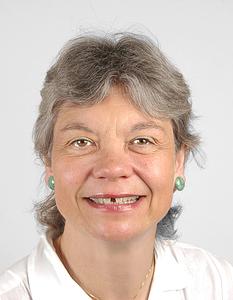
She got the Master Degree in Electrical Engineering in 1982 from EPFL. Then, she worked in Geneva up to 1990 as a Senior Design Engineer in telecommunications at the European research center of Motorola. From 1990 up to 1995, she did her PhD thesis at the Chaire des Circuits et Systemes at EPFL in the domain of impedance broadband matching circuits. Since 1995, she is responsible at EPFL for the RFIC group. She has participated to different Swiss research projects as well as European projects dedicated to data communication of sensors nodes (e.g. MuMoR, Minami European projects) as well as remote powering of sensor nodes. Her main domains of interest are telecom applications (e.g. Impulse radio Ultra-Wide Band, super-regenerative receivers, RFIDs)as well as biomedical applications. She has been the coordinator of European projects (e.g. FP6 SUPREGE, FP7 Ultrasponder)and of Swiss projects (e.g. CAPED CTI project, NEURO-IC SNF project).
Research
Research
Catherine Dehollain is responsible for research projects at Swiss level (SNF projects, CTI projects) as well as at European level (FP7 projects, Marie-Curie projects). Her activities are focused on wireless data communications of sensor nodes for telecoms applications and biomedical applications. She is also interested by remote powering of sensor nodes in order to avoid the use of a micro-battery or to use a rechargeable micro-battery. Moreover, she is interested by the domain of electrical filters as well as broadband impedance matching circuits. Since 15 years, she has a large activity dedicated to super-regenerative receivers as well as RFID circuits.
Teaching & PhD
Past EPFL PhD Students
Oguz Atasoy (2013), Mehrdad Azizighannad (2014), Edmund James Colli-Vignarelli (2012), Erkan Isa (2012), Sylvain Paul Fernand Joly (2021), Kerem Kapucu (2015), Onur Kazanç (2014), Enver Gürhan Kilinç (2014), Xiao Liu (2014), Francesco Mazzilli (2013), Alp Oguz (2013), Roberto La Rosa (2022), Kanber Mithat Silay (2012), Omid Talebi Amiri (2014), Prakash Thoppay Egambaram (2010), Kerim Türe (2019), Bakul Vinchhi (2019), Shenjie Wang (2014), Gürkan Yilmaz (2014)
Past EPFL PhD Students as codirector
Mustafa Besirli (2023), Guillaume Ding (2009), Mohammad Javad Karimi (2024), Imre Kovacs (2009), Naci Pekçokgüler (2023), Nicolas Pillin (2010), Wolfgang Amadeus Vitale (2016)
Courses
MICRO-617
The course provides in depth knowledge on how to design an energy autonomous microsystem embedding sensors with wireless transmission of information. It covers the energy generation, power management, and data processing and transmission with an emphasis on low-power and energy efficient operation.