
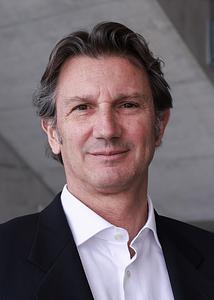
Giovanni Boero
EPFL STI IMT LMIS1
BM 3110 (Bâtiment BM)
Station 17
1015 Lausanne
+41 21 693 66 75
Office:
BM 3110
EPFL › STI › IEM › LMIS1
Website: https://lmis1.epfl.ch/
+41 21 693 66 75
EPFL › STI › STI-SMT › SMT-ENS
+41 21 693 66 75
EPFL › VPA › VPA-AVP-DLE › AVP-DLE-EDOC › EDMI-GE
Website: https://go.epfl.ch/phd-edmi
+41 21 693 66 75
EPFL › VPA › VPA-AVP-DLE › AVP-DLE-EDOC › CDOCT
Expertise
Nuclear magnetic resonance (NMR), Electron spin resonance (ESR), Ferromagnetic resonance (FMR), RF/MW discrete and integrated electronics, Magnetic sensors, Noise phenomena.
Mission
Short CV
Workplaces:
1996-present: Ecole Polytechnique Federale de Lausanne (EPFL), Lausanne, Switzerland.
1994-1996: Organization Europeenne pour la Recherche Nucleaire (CERN),Geneva,Switzerland.
1993-1995: Fermi National Accelerator Laboratory (FNAL), Batavia, IL, USA.
Education:
2000: PhD, Ecole Polytechnique Federale de Lausanne (EPFL), Lausanne, Switzerland
1994: Laurea in Physics, Università di Genova, Genova, Italy
Teaching & PhD
PhD Students
Moustafa Mohamed Bahaa Abdelwahab Elsayed Alabd, Xinwei Li, Mohammadparsa Mirzaeisarmad
Past EPFL PhD Students
Anthony Jean Beaumont (2020), Malika Bouterfas (2008), André Chatel (2026), Marco Grisi (2017), Gabriele Gualco (2015), Anton Malovichko (2021), Alessandro Valentino Matheoud (2019), Enrica Montinaro (2017), Nergiz Sahin Solmaz (2023)
Past EPFL PhD Students as codirector
Jens Anders (2011), Mario Andres Chavarria Varon (2016), Jonas Gustav Henriksson (2014), Marc Lany (2010), Schahrazede-Lila Mouaziz (2007), Matthieu Rüegg (2020), Roberto Russo (2025), Tolga Yalçin (2007)
Courses
General physics : electromagnetism
PHYS-201(c)
Introduction to fluids mechanics, to electromagnetism, and to wave phenomena.
MEMS Actuator practicals
MICRO-501
The goal of this practical work is to create thermal micro-actuators consisting of micro-cantilevers made out of silicon dioxide and covered by chromium meander-shaped electrical tracks and contact pads.
MEMS sensors practicals
MICRO-503
The objective of this practical is to apply in specific experimental settings the knowledge acquired in various MEMS related class.
Micro-magnetic field sensors and actuators
MICRO-602
The course provides the basis to understand the physics, the key performance, and the research and industrial applications of magnetic sensors and actuators. Together with a detailed introduction to magnetism, several magnetic sensors and actuators are studied.
Nanotechnology
MICRO-530
This course gives the basics for understanding nanotechnology from an engineer's perspective: physical background, materials aspects and scaling laws, fabrication and imaging of nanoscale devices.
Robotics practicals
MICRO-453
The goal of this lab series is to practice the various theoretical frameworks acquired in the courses on a variety of robots, ranging from industrial robots to autonomous mobile robots, to robotic devices, all the way to interactive robots.