
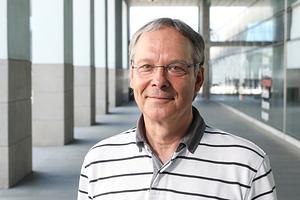
Michaël Unser
EPFL STI IMT LIB
BM 4136 (Bâtiment BM)
Station 17
1015 Lausanne
+41 21 693 51 75
+41 21 693 11 85
Office:
BM 4136
EPFL › STI › IEM › LIB
Website: https://bigwww.epfl.ch/
+41 21 693 51 75
Office:
BM 4136
EPFL › VPA › VPA-AVP-DLE › AVP-DLE-EDOC › EDEE-ENS
+41 21 693 51 75
Office:
BM 4136
EPFL › SB › SB-SMA › SMA-ENS
Website: https://sma.epfl.ch/
Expertise
Prof. Unser is a fellow of the IEEE (1999), an EURASIP fellow (2009), and a member of the Swiss Academy of Engineering Sciences. He is the recipient of several international prizes including five IEEE-SPS Best Paper Awards, two Technical Achievement Awards from the IEEE (2008 SPS and EMBS 2010), the 2018 Technical Achievement Award from EURASIP, the 2020 Career Achievement Award from the IEEE Society on Engineering in Medicine and Biology (EMBS), and the 2025 IEEE SPS Norbert Wiener Society Award. He was awarded three ERC AdG grants: FUNSP (2011-2016), GlobalBioIm (2016-2021), and FunLearn (2021-2026).
Research unit
Awards
Norbert Wiener Society Award
IEEE Signal Processing Society
2025
Education Award
EPFL's Section of Micro-Engineering (SMT)
2022
Academic Career Achievement Award
IEEE Engineering in Medicine and Biology Society,
2020
2019 Best Paper Award
IEEE Signal Processing Society
2019
Technical Achievement Award
European Association for Signal and Image Processing
2018
2017 Best Paper Award
IEEE Signal Processing Society
2017
Technical Achievement Award
IEEE Engineering in Medicine and Biology Society
2011
Claude Shannon-Harry Nyquist Technical Achievement Award
IEEE Signal Processing Society
2008
Teaching & PhD
PhD Students
Stanislas Ducotterd, Bassam El Rawas, Vincent Patrick Lawrence Guillemet, Youssef Haouchat, Zhiyuan Hu, Mehrsa Pourya
Past EPFL PhD Students
François Aguet (2009), Muthuvel Arigovindan (2005), Shayan Aziznejad (2022), Anaïs Badoual (2019), Jean-Charles Baritaux (2012), Pakshal Narendra Bohra (2024), Emrah Bostan (2016), Aurélien Bourquard (2013), Kunal Narayan Chaudhury (2011), Thomas Jean Debarre (2022), Pouya Dehghani Tafti (2011), Ricard Delgado Gonzalo (2013), Laurène Donati (2020), Julien René Fageot (2017), Manuela Feilner (2002), Alexis Goujon (2024), Matthieu Guerquin-Kern (2012), Harshit Gupta (2020), Stefan Horbelt (2001), Mathews Jacob (2003), Slavica Jonic (2003), Ulugbek Kamilov (2015), Ildar Khalidov (2009), Jan Kybic (2001), Michael Liebling (2004), Yan Liu (2026), Florian Luisier (2010), Maria Arrate Munoz Barrutia (2002), Masih Nilchian (2015), Pedram Pad (2017), Thanh-An Michel Pham (2022), Zsuzsanna Püspöki (2016), Sathish Ramani (2009), Daniel Andreas Schmitter (2017), Michael Sühling (2004), Virginie Uhlmann (2017), Cédric Vonesch (2009)
Courses
Fundamentals of Image Analysis
EE-805
This summer school is an hands-on introduction on the fundamentals of image analysis for scientists. A series of lectures provide students with the key concepts in the field, and are followed by practical sessions with popular software on the participants' own image-analysis software.
Image processing I
MICRO-511
Introduction to the basic techniques of image processing. Introduction to the development of image-processing software and to prototyping using Jupyter notebooks. Application to real-world examples in industrial vision and biomedical imaging.
Image processing II
MICRO-512
Study of advanced image processing; mathematical imaging. Development of image-processing software and prototyping in Jupyter Notebooks; application to real-world examples in industrial vision and biomedical imaging.
Signals and systems I (for MT)
MICRO-310(a)
Introduction of the basic concepts and mathematical tools for the characterization of signals and for the analysis and design of linear systems (filters or transmission channels). Application of these techniques to signal processing and communications.
Signals and systems I (for SV)
MICRO-310(b)
Introduction of the basic concepts and mathematical tools for the analysis and characterization of signals, the design of processing algorithms, and the linear modeling of systems for students in the life sciences. Application of these techniques to signal processing and communications.