
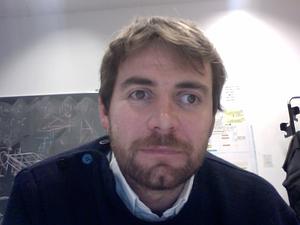
Benoît Labit
Nationality: French, Swiss
EPFL SB SPC-TCV
PPB 118 (Bâtiment PPB)
Station 13
1015 Lausanne
+41 21 693 45 62
Office:
PPB 118
EPFL › SB › SPC › SPC-TCV
Website: https://spc.epfl.ch/
Expertise
Plasma turbulence
Experimental physics
Numerical simulations
Current work
PhD Thesis
Tokamak electron heat transport by direct numerical simulation of small scale turbulence
In a fusion machine, understanding plasma turbulence, which causes a degradation of the measured energy confinement time, would constitute a major progress in this field. In tokamaks, the measured ion and electron thermal conductivities are of comparable magnitude. The possible sources of turbulence are the temperature and density gradients occurring in a fusion plasma. Whereas the heat losses in the ion channel are reasonably well understood, the origin of the electron losses is more uncertain. In addition to the the radial velocity associated to the fluctuations of the electric field, electrons are more affected than ions by the magnetic field fluctuations. In experiments, the confinement time can be conveniently expressed in terms of dimensionless parameters. Although still somewhat too imprecise, these scaling laws exhibit strong dependencies on the normalized pressure, β or the normalized Larmor radius, Ï*.
The present thesis assesses whether a tridimensional, electromagnetic, nonlinear fluid model of plasma turbulence driven by a specific instability can reproduce the dependence of the experimental electron heat losses on the dimensionless parameters β and Ï*. The investigated interchange instability is the Electron Temperature Gradient driven one (ETG). The model is built by using the set of Braginskii equations. The developed simulation code is global in the sense that a fixed heat flux is imposed at the inner boundary, leaving the gradients free to evolve.
From the nonlinear simulations, we have put in light three characteristics for the ETG turbulence: the turbulent transport is essentially electrostatic; the potential and pressure fluctuations form radially elongated cells called streamers; the transport level is very low compared to the experimental values.
The thermal transport dependence study has shown a very small role of the normalized pressure, which is in contradiction with the Ohkawa
Education
Docteur es Sciences
| mention Rayonnement et Plasmas
2002 – 2002
Universit� de Provence Aix-Marseille I
Directed by
Dr. M. Ottaviani et Dr. D. F. Escande
Professionals experiences
Collaborateur scientifique
Post-doc
Doctorant
201311
Teaching & PhD
PhD Students
Martino Bonisolli, Robert Andrew Kueter Forte, Mackenzie Peter-Fulford Van Rossem, Andrii Shytikov, Haoran Zhang
Past EPFL PhD Students as codirector
Courses
Plasma Diagnostics in Basic Plasma Physics Devices and Tokamaks: from Principles to Practice
PHYS-732
The programme will allow students to learn plasma diagnostics and data processing methods of modern fusion experiments and to bridge the gap between diagnostics theory and experimental practice.