
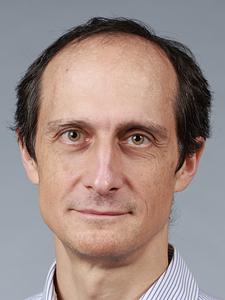
Viktor Kuncak
Il - He/him
EPFL IC IINFCOM LARA
INR 318 (Bâtiment INR)
Station 14
1015 Lausanne
+41 21 693 52 81
+41 21 693 49 43
Office:
INR 318
EPFL › IC › IINFCOM › LARA
Website: https://lara.epfl.ch
+41 21 693 52 81
Office:
INR 318
EPFL › IC › IC-SIN › SIN-ENS
Website: https://sin.epfl.ch
+41 21 693 52 81
Office:
INR 318
EPFL › IC › IC-SSC › SSC-ENS
Website: https://ssc.epfl.ch
Expertise
Mission
Detailed page
Awards
ERC grant
European Research Council
2012
Selected publications
Deciding Boolean Algebra with Presburger Arithmetic
Viktor Kuncak, Hai Huu Nguyen, and Martin Rinard
Published in Journal of Automated Reasoning, 36(3), 2006 in
Modular Pluggable Analyses for Data Structure Consistency
Viktor Kuncak, Patrick Lam, Karen Zee, and Martin Rinard
Published in IEEE Transactions on Software Engineering, 32(12), 2006 in
Relational Analysis of Algebraic Datatypes
Viktor Kuncak and Daniel Jackson
Published in Joint 10th European Software Engineering Conference and 13th ACM SIGSOFT Symposium on the Foundations of Software Engineering, 2005 in
Structural Subtyping of Non-Recursive Types is Decidable
Viktor Kuncak and Martin Rinard
Published in Eighteenth Annual IEEE Symposium on Logic in Computer Science, 2003 in
Role Analysis
Viktor Kuncak and Patrick Lam and Martin Rinard
Published in Proceedings of the 29th Annual ACM Symposium on Principles of Programming Languages, 2002 in
Infoscience
Teaching & PhD
PhD Students
Matthieu Bovel, Samuel Chassot, Sankalp Gambhir, Lazar Milikic, Auguste Poiroux
Past EPFL PhD Students
Régis William Blanc (2017), Eva Darulova (2014), Romain Edelmann (2021), Simon Guilloud (2026), Tihomir Gvero (2015), Hossein Hojjat (2013), Ravichandhran Kandhadai Madhavan (2017), Etienne Kneuss (2016), Manos Koukoutos (2019), Mikaël Mayer (2017), Dragana Milovancevic (2025), Ruzica Piskac (2011), Rodrigo Raya (2023), Georg Stefan Schmid (2022), Philippe Suter (2012), Nicolas Voirol (2019), Qiang Wang (2017)
Past EPFL PhD Students as codirector
Courses
Computer language processing
CS-320
We teach the fundamental aspects of provably correct analysis and interpretation of computer languages, including the techniques to build compilers and to demonstrate correctness of key compiler phases. The course may require presence in many weeks due to in-class examinations.
Formal verification
CS-550
We introduce formal verification as an approach for developing highly reliable systems. Formal verification finds proofs that computer systems work under all relevant scenarios. We will learn how to use formal verification tools and explain the theory and the practice behind them.
Software construction
CS-214
Learn how to design and implement reliable, maintainable, and efficient software using a mix of programming skills (declarative style, higher-order functions, inductive types, parallelism) and fundamental software construction concepts (reusability, abstraction, encapsulation, composition, proofs)