
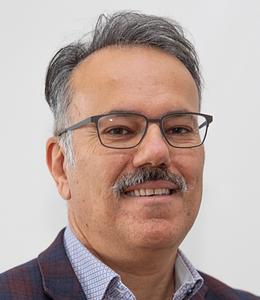
Babak Falsafi
EPFL IC IINFCOM PARSA
INJ 233 (Bâtiment INJ)
Station 14
1015 Lausanne
+41 21 693 55 92
+41 21 693 13 93
Office:
INJ 233
EPFL › IC › IINFCOM › PARSA
Website: https://parsa.epfl.ch/
+41 21 693 55 92
EPFL › IC › IC-SIN › SIN-ENS
Website: https://sin.epfl.ch
+41 21 693 55 92
EPFL › IC › IC-SSC › SSC-ENS
Website: https://ssc.epfl.ch
+41 21 693 55 92
EPFL › SB › SB-SMA › SMA-ENS
Website: https://sma.epfl.ch/
Expertise
NEWS
Network bandwidth is projected to grow at 20% a year for a decade thanks to optics. Logic density is lagging behind at 15% a year and slowing down resulting a "datacenter tax". Optimus Prime a data transformation accelerator, NebuLA a hardware-terminated network stack, and Cerebros an RPC processor are examples of how to mitigate the datacenter tax in the post-Moore era. Great to see that Google has followed up with their own data transformation accelerator in 2022.
See our paper on "Rebooting Virtual Memory with Midgard" for a novel approach to future-proof virtual memory. Here is a news snippet.
Numerical training of DNNs is converging on fixed point with orders of magnitude improvement in logic, memory, power and bandwidth. See our blog.
RESEARCH
He investigates techniques to address these challenges in the context of the following projects:
- CloudSuite: A Benchmark Suite for Scale-Out Workloads
- ColTraIn: Co-Located Training and Inference DNN Accelerators
- HARNESS: Heterogeneous Architectures for Next-Generation Server Systems
- Midgard: Future-Proofing Virtual Memory
- QFlex: Fast, Full-System Open-Source Server Simulation/Emulation
- VISA: Cloud-Native CPUs
Selected Talks
HPCA Keynote, 2022.
Post-Moore AI Infrastructure
Facebook SysML Talk, 2021.
Post-Moore Server Architecture
ICS Keynote, 2020 (Video on YouTube!).
Server Architecture for the Post-Moore Era
HotDC Keynote, 2017.
Awards
Elected Fellow of Association for Computing Machinery (ACM)
2015
Elected Fellow of the Institute of Electrical and Electronics Engineers
2012
Sloan Research Fellowship
Alfred P. Sloan Foundation
2004
Infoscience
Teaching & PhD
PhD Students
Arunkrishna Annai Madalam Sivasubramanian, Ayan Chakraborty, Alireza Foroodnia, Yuanlong Li, Shanqing Lin, Pooria Poorsarvi Tehrani, Alexandros Poupakis, Shashwat Shrivastava
Past EPFL PhD Students
Alexandros Daglis (2018), Mario Paulo Drumond Lages De Oliveira (2020), Sotiria Fytraki (2014), Ognjen Glamocanin (2023), Siddharth Gupta (2023), Simla Burcu Harma (2026), Djordje Jevdjic (2015), Ilknur Cansu Kaynak (2015), Yusuf Onur Koçberber (2015), Pejman Lotfi Kamran (2013), Dina Gamaleldin Ahmed Shawky Mahmoud (2024), Dejan Novakovic (2014), Javier Picorel Obando (2017), Arash Pourhabibi Zarandi (2021), Mark Johnathon Sutherland (2022), Stavros Volos (2015)
Past EPFL PhD Students as codirector
Atri Bhattacharyya (2024), Tao Lin (2022), Stanko Novakovic (2017)
Courses
Advanced multiprocessor architecture
CS-471
Multiprocessors are basic building blocks for all computer systems. This course covers the architecture and organization of modern multiprocessors, prevalent accelerators (e.g., GPU, TPU), and datacenters. It includes a research project on multiprocessors and post-Moore era datacenters.
Parallelism and concurrency in software
CS-302
From sensors,to smart phones,to the world's largest datacenters and supercomputers, parallelism & concurrency is ubiquitous in modern computing.There are also many forms of parallel & concurrent execution in modern platforms with varying degrees of ease of programmability,performance & efficiency.
Topics in Machine Learning Systems
CS-723
This course will cover the latest technologies, platforms and research contributions in the area of machine learning systems. The students will read, review and present papers from recent venues across the systems for ML spectrum.
Topics on Datacenter Design
CS-728
Modern datacenters with thousands of servers and multi-megawatt power budgets form the backbone of our digital universe. ln this course, we will survey a broad and comprehensive spectrum of datacenter design topics from workloads, to server architecture and infrastructure.