
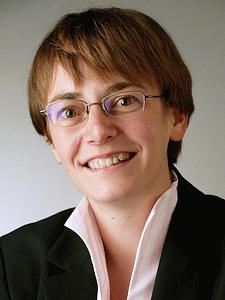
Cécile Hébert
EPFL SB IPHYS LSME
PH D2 354 (Bâtiment PH)
Station 3
1015 Lausanne
+41 21 693 05 71
+41 21 693 53 49
Office:
PH D2 354
EPFL › SB › IPHYS › LSME
Website: https://lsme.epfl.ch
+41 21 693 05 71
EPFL › VPA › VPA-AVP-E › AVP-E › AVP-E-EPFL-GYMN
+41 21 693 05 71
EPFL › SB › SB-SPH › SPH-ENS
Website: https://sph.epfl.ch/
+41 21 693 05 71
EPFL › SB › SB-SPH › SPH-GE
Website: https://sph.epfl.ch/
+41 21 693 05 71
EPFL › SB › SB-DEC › SB-DIR
+41 21 693 05 71
EPFL › VPA › VPA-AVP-CP › CIME › CIME-CD
Infoscience
Teaching & PhD
PhD Students
Past EPFL PhD Students
Arthur Brian Aebersold (2017), Piyush Agrawal (2017), Pierre Burdet (2012), Hui Chen (2023), Loïc Guillaume Fave (2017), Gulnaz Ganeeva (2023), Andi Idhil Ismail (2013), Emad Oveisi (2015), Stéphane Poitel (2020), Simon Schneider (2013), Wenwang Wu (2014)
Past EPFL PhD Students as codirector
Federica Landucci (2019), Guillaume Pasche (2013), Michael Stuer (2012)
Courses
Advanced physics II (thermodynamics)
PHYS-105
This course presents thermodynamics as a means of describing a large number of important phenomena in physics, chemistry, and engineering, including transport effects. An introduction to statistical physics reinforces the notions acquired thanks to microscopic modeling.
Electron Matter Interactions in Transmission Electron Microscopy
PHYS-637
This course will present the fundamentals of electronâmatter interactions, as occuring in the energy range available in modern transmission electron microscopes, namely 60-300 keV electrons. Diffraction and high-resolution image formation as well as electron energy-loss spectrometry will be covere
General physics : mechanics (flipped classroom)
PHYS-101(l)
The course establishes the basic notions that will allow the student to have a better understanding of the physical phenomena in mechanics. The students acquires the capability to quantitatively analyse the consequences of these effects with appropriate theoretical tools.