
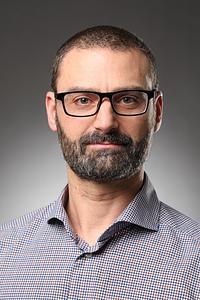
Colin Jones
EPFL STI IGM LA3
ME C2 408 (Bâtiment ME)
Station 9
1015 Lausanne
+41 21 693 11 71
Office:
ME C2 408
EPFL › STI › IGM › LA3
Website: https://la.epfl.ch/
+41 21 693 11 71
EPFL › STI › STI-SGM › SGM-ENS
+41 21 693 11 71
EPFL › STI › IGM › IGM-GE
+41 21 693 11 71
EPFL › STI › STI-DEC › STI-DIR
Publications
Education
BASc
| Electrical engineering and mathematics1994 – 2000 University of British Columbia
MASc
| Electrical engineering2000 – 2002 University of British Columbia, Canada
PhD
| Control theory
2002 – 2005
Cambridge, UK
Directed by
Jan Maciejowski
Research Interests
Details of ongoing research can be found at la.epfl.ch
Infoscience
Infoscience
Teaching & PhD
PhD Students
Andrea Gattiglio, Pietro Mello Rella, Tudor Andrei Oancea, Jicheng Shi, Fenglong Song, Johannes Waibel, Wenbin Wang, Shaohui Yang, Yan Zhang, Arion Louis Viktor Zimmermann
Past EPFL PhD Students
Andrea Alessandretti (2016), Altug Bitlislioglu (2018), Sanket Sanjay Diwale (2019), Luca Fabietti (2019), Francisco Fernandes Castro Rego (2018), Tomasz Tadeusz Gorecki (2017), Jean-Hubert Hours (2016), Manuel Pascal Koch (2025), Milan Korda (2016), Yingzhao Lian (2023), Petr Listov (2022), Emilio Maddalena (2023), Loris Di Natale (2024), Ivan Pejcic (2019), Ye Pu (2016), Faran Ahmed Qureshi (2017), Paul Scharnhorst (2024), Roland Schwan (2026), Harsh Ambarishkumar Shukla (2021), Georgios Stathopoulos (2018), Wenjie Xu (2025)
Courses
Control systems + TP
ME-321
Provides the students with basic notions and tools for the analysis and control of dynamic systems. Shows them how to design controllers and analyze the performance of controlled systems.
Model predictive control
ME-425
Provide an introduction to the theory and practice of Model Predictive Control (MPC). Main benefits of MPC: flexible specification of time-domain objectives, performance optimization of highly complex multivariable systems and ability to explicitly enforce constraints on system behavior.