
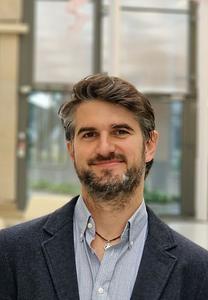
Eduardo Moraud
EPFL STI INX-STI SPARK
B1 5 267.040 (Campus Biotech bâtiment B1)
Ch. des Mines 9
1202 Genève
+41 21 693 28 92
Office:
B1 5 267.040
EPFL › STI › INX-STI › SPARK
Website: https://sti.epfl.ch/
EPFL STI INX-STI SPARK
B1 5 267.040 (Campus Biotech bâtiment B1)
Ch. des Mines 9
1202 Genève
+41 21 693 28 92
Office:
B1 5 267.040
EPFL › SV › INX-SV › UPMORAUD2
EPFL STI INX-STI SPARK
B1 5 267.040 (Campus Biotech bâtiment B1)
Ch. des Mines 9
1202 Genève
+41 21 693 28 92
Office:
B1 5 267.040
EPFL › IC › INX-IC › UPMORAUD3
EPFL STI INX-STI SPARK
B1 5 267.040 (Campus Biotech bâtiment B1)
Ch. des Mines 9
1202 Genève
+41 21 693 28 92
Office:
B1 5 267.040
EPFL › SV › SV-SSV › SSV-ENS
Website: https://sv.epfl.ch/education
Expertise
Mission
Awards
Robert Bing prize
Swiss Academy of Medical Sciences
2026
Teaching & PhD
PhD Students
Flore Marie Munier-Jolain, Olivia Caroline Ruggaber, Paula Sanchez Lopez, Ruijia Wang
Courses
Health A: Innovation, Equity, Sustainability
HUM-125(a)
The course provides an interdisciplinary examination of key global health challenges, focusing on biomedical innovations, pharmaceuticals, sustainability, mental health, and health policies. It offer a critical skillset to engineering students approaching these complex health challenges.
Translational neuroengineering
NX-423
This course integrates knowledge in basic, systems, clinical and computational neuroscience, and engineering with the goal of translating this integrated knowledge into the development of novel methods, technology for the clinical application for patients suffering from neuropsychiatric disorders.