
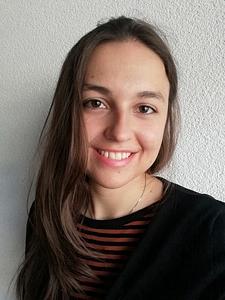
Francesca Rodino
Nationality: Italian
EPFL STI IEM SCI-STI-SC
MC A3 196 (Bâtiment MC)
Rue de la Maladière 71b, CP 526
2002 Neuchâtel 2
+41 21 693 80 24
Office:
MC A3 196
EPFL › STI › IEM › SCI-STI-SC
Website: https://www.epfl.ch/labs/bci/
Expertise
Electrochemical Biosensors
Sensors and Biosensors interfaces | front-end electronics
Biomedical circuits and systems
Sensors and Biosensors interfaces | front-end electronics
Biomedical circuits and systems
Francesca Rodino received the B.Sc. and M.Sc. degrees in Biomedical Engineering from the Politecnico di Torino, Turin, Italy, in 2019 and 2022, respectively. She developed her Master's project in the field of cortical neuroprosthesis devices for artificial vision in collaboration with the Integrated Circuits Laboratory (ICLAB) at école Polytechnique Fédérale de Lausanne (EPFL) in Switzerland. Currently, she is conducting her Ph.D. in Microsystems and Microelectronics (EDMI) at EPFL's Electrical and Microengineering Institute (IEM) - Microcity, Neuchatel, Switzerland.
Her Ph.D. project is focused on developing an intelligent platform for drug response in precision oncology. Her current research interests include electrochemical biosensors and frontend electronics for multiple drug monitoring in personalized medicine and therapy.
Her Ph.D. project is focused on developing an intelligent platform for drug response in precision oncology. Her current research interests include electrochemical biosensors and frontend electronics for multiple drug monitoring in personalized medicine and therapy.
Education
B.Sc.
| Biomedical Engineering2019 – 2019 Politecnico di Torino (Italy)
M.Sc.
| Biomedical Instrumentation2022 – 2022 Politecnico di Torino (Italy)
Research
Other
- Tavakolidakhrabadi, A., Domange, T., Nalm, C., Rodino, F., Meimandi, A., Bessire, C., & Carrara, S. (2024). A Novel Microfluidic System for Capacitive Detection via Magnetophoretic Separation of Malaria-Infected Red Blood Cells. IEEE Sensors Letters. DOI: 10.1109/LSENS.2024.3451238
- Barbruni, G. L., Rodino, F., Ros, P. M., Demarchi, D., Ghezzi, D., & Carrara, S. (2024). A Wearable Real-Time System for Simultaneous Wireless Power and Data Transmission to Cortical Visual Prosthesis. IEEE Transactions on Biomedical Circuits and Systems. DOI:10.1109/TBCAS.2024.3357626
- Herold, G., Rodino, F., Golparvar, A., Reynaert, E., & Carrara, S. (2023). Enhancing Water Safety in Decentralized Water Reuse Systems with Low-Cost Prussian Blue Amperometric Sensors for Free Chlorine Monitoring. IEEE Sensors Letters. DOI:10.1109/LSENS.2023.3307084
- Rodino, F. (2022). Design and Development of an External Processing Unit for Wireless Power and Data Transmission to Miniaturized Neural Implants for Reverting Blindness (M.Sc. Thesis. Politecnico di Torino).
PhD Research
- Rodino, F., Bartoli, M. and Carrara, S., 2023. Simultaneous and Selective Detection of Etoposide and Methotrexate with Single Electrochemical Sensors for Therapeutic Drug Monitoring. IEEE Sensors Letters. DOI: 10.1109/LSENS.2023.3300817
- Du, L., Thoma, Y., Rodino, F., & Carrara, S. (2024). Automatic simulation of electrochemical sensors by machine learning for drugs quantification. Electrochimica Acta, 491, 144304. DOI: https://doi.org/10.1016/j.electacta.2024.144304
- Du, L., Rodino, F., Thoma, Y., & Carrara, S. (2024). Identification and Quantification of Multiple Drugs by Machine Learning on Electrochemical Sensors for Therapeutic Drug Monitoring. IEEE Sensors Letters. DOI:10.1109/LSENS.2024.3418197
- Matsumoto, T., Du, L., Rodino, F., Thoma, Y., Premachandra, C., & Carrara, S. (2024). Optimized Quantification of Multiple Drug Concentrations by Weighted MSE with Machine Learning on Electrochemical Sensor. IEEE Sensors Letters. DOI:10.1109/LSENS.2024.3452009
Teaching & PhD
Other Activities
EPFL team coach for the international 'SensUs' competition.
Teaching Assistant
- Bio-nano-chip design (EE-517): Introduction to heterogeneous integration for Nano-Bio-CMOS sensors on Chip. Understanding and designing of active Bio/CMOS interfaces powered by nanostructures.
- MEMS practicals II (MICRO-503): Objective of this practical is to apply in specific experimental settings the knowledge acquired in various MEMS related class.
- Sciences et technologies de l'électricité (printemps) (EE-105): The objective is to learn the fundamentals of electrical engineering that enable you to understand, model, and use the appropriate tools to analyze simple electrical circuits.