
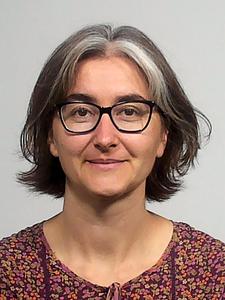
Lenka Zdeborová
EPFL SB IPHYS SPOC1
BSP 722 (Cubotron UNIL)
Rte de la Sorge
1015 Lausanne
+41 21 693 83 27
Office:
BSP 722
EPFL › SB › IPHYS › SPOC1
Website: https://www.epfl.ch/labs/spoc/
EPFL SB IPHYS SPOC1
BSP 722 (Cubotron UNIL)
Rte de la Sorge
1015 Lausanne
+41 21 693 83 27
Office:
BSP 722
EPFL › SB › SB-SPH › SPH-ENS
Website: https://sph.epfl.ch/
EPFL SB IPHYS SPOC1
BSP 722 (Cubotron UNIL)
Rte de la Sorge
1015 Lausanne
+41 21 693 83 27
Office:
BSP 722
EPFL › VPA › VPA-AVP-DLE › AVP-DLE-EDOC › EDPY-ENS
EPFL SB IPHYS SPOC1
BSP 722 (Cubotron UNIL)
Rte de la Sorge
1015 Lausanne
+41 21 693 83 27
Office:
BSP 722
EPFL › IC › IC-SIN › SIN-ENS
Website: https://sin.epfl.ch
EPFL SB IPHYS SPOC1
BSP 722 (Cubotron UNIL)
Rte de la Sorge
1015 Lausanne
+41 21 693 83 27
Office:
BSP 722
EPFL › IC › IC-SSC › SSC-ENS
Website: https://ssc.epfl.ch
Teaching & PhD
PhD Students
Fabrizio Boncoraglio, Yatin Dandi, Odilon Duranthon, Gabriele Farnè, Cédric Xavier Koller, Jorge Medina Moreira, Yizhou Xu
Past EPFL PhD Students
Hugo Chao Cui (2024), Giovanni Piccioli (2024), Emanuele Troiani (2026)
Courses
Data sciences
PHYS-231
This course introduces tools for data analysis in physics: numerical linear algebra, regression, dimensionality reduction, probability, statistics, uncertainty quantification, random walks, Monte Carlo methods and phase transitions, with Python exercises.
Lecture series on scientific machine learning
PHYS-754
This lecture presents ongoing work on how scientific questions can be tackled using machine learning. Machine learning enables extracting knowledge from data computationally and in an automatized way. We will learn on examples how this is influencing the very scientific method.
Machine learning for physicists
PHYS-467
Machine learning and data analysis are central in sciences including physics. In this course, fundamental principles and methods of machine learning will be introduced and practised.
Statistical physics of computation
PHYS-512
The students understand tools from the statistical physics of disordered systems, and apply them to study computational and statistical problems in graph theory, discrete optimisation, inference and machine learning.