
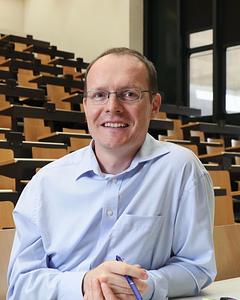
Simone Deparis

EPFL AVP-E CePRO
RLC D1 650 (Rolex Learning Center)
Station 20
1015 Lausanne

EPFL SB MATH SCI-SB-SD
MA B2 477 (Bâtiment MA)
Station 8
1015 Lausanne

EPFL SB SMA-GE
MA B2 477 (Bâtiment MA)
Station 8
1015 Lausanne

EPFL SB SMA-GE
MA B2 477 (Bâtiment MA)
Station 8
1015 Lausanne

Expertise

Simone Deparis is a professor at EPFL specializing in applied mathematics, numerical analysis, and the didactics of university-level mathematics. His research spans computational modeling for biomedical applications and innovations in mathematics education, with a focus on equity, self-efficacy, and assessment reform in large STEM cohorts.

Mission

Our group conducts research at the intersection of applied mathematics and learning sciences. In applied mathematics, we focus on modeling and simulation of complex systems, particularly cardiovascular flows, using advanced numerical methods, model order reduction, and physics-informed machine learning. In parallel, we investigate teaching and learning in higher education, with an emphasis on first-year mathematics, innovative assessment practices, and the role of computational tools in fostering equity and student success.

Education

Applied Mathematics

| Numerical analysis of axisymmetric flows and methods for fluid-structure interaction arising in blood flow simulation

2001 – 2004 EPFL
Directed by Alfio Quarteroni

Applied Mathematics

|

1998 – 1999 Ecole Polytechnique Paris et EPFL

Mathematics

|

1992 – 1997 ETH Zurich

Professionals experiences

Post-doc

Post-doctoral fellow and associate in the Department of Mechanical Engineering

Awards

Credit Suisse Award for Best Teaching

EPFL

2018

Publications

2026

[1] Generalization of the total linearization method to three-dimensional free-surface flows

T. BenkleyS. DeparisP. RicciA. Mortensen

Computer Methods in Applied Mechanics and Engineering

2026

Vol. 451.

DOI : 10.1016/j.cma.2025.118691

2023

[2] DeepBND: A machine learning approach to enhance multiscale solid mechanics

F. RochaS. DeparisP. AntolinA. Buffa

Journal of Computational Physics

2023

Vol. 479, p. 111996.

DOI : 10.1016/j.jcp.2023.111996

2022

[3] PDE-Aware Deep Learning for Inverse Problems in Cardiac Electrophysiology

R. TenderiniS. PaganiA. QuarteroniS. Deparis

SIAM Journal on Scientific Computing

2022

Vol. 44, num. 3, p. B605 - B639.

DOI : 10.1137/21M1438529

2021

[4] Model order reduction of flow based on a modular geometrical approximation of blood vessels

L. PegolottiM. R. PfallerA. L. MarsdenS. Deparis

Computer Methods in Applied Mechanics and Engineering

2021

Vol. 380, p. 113762.

DOI : 10.1016/j.cma.2021.113762

2020

[5] Analysis of morphological and haemodynamical indexes in abdominal aortic aneurysms as preliminary indicators of intraluminal thrombus deposition

C. M. ColciagoS. DeparisM. DomaninC. RiccobeneE. Schenone  et al.

Biomechanics and Modeling in Mechanobiology

2020

Vol. 19, num. 3, p. 1035 - 1053.

DOI : 10.1007/s10237-019-01269-4

2019

[6] Coupling non-conforming discretizations of PDEs by spectral approximation of the Lagrange multiplier space

S. DeparisA. IubattiL. Pegolotti

ESAIM: Mathematical Modelling and Numerical Analysis

2019

Vol. 53, num. 5, p. 1667 - 1694.

DOI : 10.1051/m2an/2019030

2018

[7] Multi space reduced basis preconditioners for large-scale parametrized PDEs

N. Dal SantoS. DeparisA. ManzoniA. Quarteroni

SIAM Journal on Scientific Computing

2018

Vol. 40, num. 2, p. A954 - A983.

DOI : 10.1137/16M1089149

[8] The LifeV library: engineering mathematics beyond the proof of concept

L. BertagnaS. DeparisL. FormaggiaD. FortiA. Veneziani

ArXiv

2018

Vol. [math.NA], p. 1710.06596.

2016

[9] Multiphysics Computational Modeling in C-Heart

J. LeeA. CooksonI. RoyE. KerfootL. Asner  et al.

SIAM Journal of Scientific Computing

2016

Vol. 38, num. 3, p. C150 - C178.

DOI : 10.1137/15M1014097

[10] Parameter estimates for the Relaxed Dimensional Factorization preconditioner and application to hemodynamics

M. BenziS. DeparisG. GrandperrinA. Quarteroni

Computer Methods in Applied Mechanics and Engineering

2016

Vol. 300, num. 1, p. 129 - 145.

DOI : 10.1016/j.cma.2015.11.016

2014

[11] A Rescaled Localized Radial Basis Function Interpolation On Non-Cartesian And Nonconforming Grids

S. DeparisD. FortiA. Quarteroni

Siam Journal On Scientific Computing

2014

Vol. 36, num. 6, p. A2745 - A2762.

DOI : 10.1137/130947179

2013

[12] Physiological simulation of blood flow in the aorta: comparison of hemodynamic indices as predicted by 3-D FSI, 3-D rigid wall and 1-D models

P. ReymondP. CrosettoS. DeparisA. QuarteroniN. Stergiopulos

Medical Engineering & Physics

2013

Vol. 35, num. 6, p. 784 - 791.

DOI : 10.1016/j.medengphy.2012.08.009

[13] Implicit coupling of one-dimensional and three-dimensional blood flow models with compliant vessels

A. C. I. MalossiP. J. BlancoP. CrosettoS. DeparisA. Quarteroni

Multiscale Modeling & Simulation

2013

Vol. 11, num. 2, p. 474 - 506.

DOI : 10.1137/120867408

2011

[14] Parallel Algorithms for Fluid-Structure Interaction Problems in Haemodynamics

P. CrosettoS. DeparisG. FouresteyA. Quarteroni

Siam Journal on Scientific Computing

2011

Vol. 33, num. 4, p. 1598 - 1622.

DOI : 10.1137/090772836

2006

[15] A truncated Fourier/finite element discretization of the Stokes equations in an axisymmetric domain

Z. BelhachmiC. BernardiS. DeparisF. Hecht

Mathematical Models and Methods in Applied Sciences

2006

Vol. 16, num. 2, p. 233 - 263.

DOI : 10.1142/S0218202506001133

Teaching & PhD

PhD Students

Fabio Marcinno, Manuela Pineros-Rodriguez, Micol Bassanini, Francesco Sala

Past EPFL PhD Students

Luca Pegolotti, Riccardo Tenderini

Past EPFL PhD Students as codirector

Paolo Crosetto, Adelmo Cristiano Innocenza Malossi, Gwenol Grandperrin, Radu Popescu, Claudia Maria Colciago, Davide Forti

Courses

Linear algebra (flipped classroom)

MATH-111(pi)

The purpose of the course is to introduce the basic notions of linear algebra and its applications. This class is given with a flipped design.

Teaching STEM: a problem solving approach

ENG-644

Problem solving is a core engineering skill. This course explores relevant heuristics, epistemologies, metacognitive skills and evidence-informed teaching strategies for developing problem solving skills that transfer from paper-based exercises to complex, real world engineering situations.

Past courses

Analysis 1, Linear Algebra, Numerical analysis,
Programming concepts in scientific computing,
Geometry, Numerical analysis and Computational Mathematics, Numerical approximation of partial differential equations