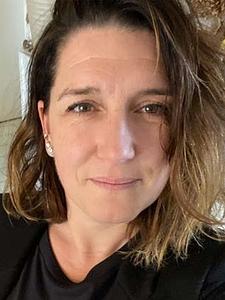
An architect and archaeologist, Aurélie Terrier has been developing for more than two decades a singular expertise at the interface of architectural archaeology, digital heritage and the history of ancient built environments. Her research focuses on ancient and medieval architecture, architectural archaeology, the reuse of building materials, issues related to construction sites, new technologies and digital humanities, as well as the valorisation and restoration of heritage. Trained in architecture at the Haute École des Arts Décoratifs de Genève, she subsequently specialised in Egyptology and classical and medieval archaeology at the University of Geneva, combining throughout her trajectory professional practice, academic research and teaching. Since 2005, she has collaborated on numerous archaeological missions in Mali, Syria, Switzerland, Italy, Egypt and Greece.
Her research career began with a doctoral thesis on the medieval castral complex of Akerentia in Calabria, Italy, the first systematic architectural and archaeological study of this site, conducted within an international collaborative framework bringing together institutions from Switzerland, France and Italy. Funded by an FNS Doc.CH grant, this research laid the foundations of her methodological approach, combining large-scale data acquisition protocols, including photogrammetry, laser scanning and ground-penetrating radar, with archaeological excavations and rigorous stratigraphic analysis.
Since 2019, she has been leading the architectural and archaeological study of the Greco-Roman temple of Kom Ombo in Upper Egypt, one of the five largest sanctuaries of this period, which had until then never been the subject of such a study. Working under the authority of the Egyptian Ministry of Antiquities and in close collaboration with an international and multidisciplinary team, she has developed innovative large-scale acquisition protocols and initiated the first integrated digital ecosystem for this exceptional site. This research has been successively supported by an FNS Early Postdoc.Mobility fellowship at the CNRS IRAA laboratory in France (2019-2022) and an FNS Ambizione grant at the LAPIS laboratory at EPFL (2023-2027).
In parallel, since 2020 she has been developing the study of the Maison de Fourni on the island of Delos in Greece, in collaboration with Hélène Wurmser (Université Lyon 2/CNRS IRAA) and the École Française d'Athènes, within a collective research project bringing together specialists in architecture, archaeology, numismatics and mosaics. This research constitutes the starting point for a broader study of the North Quarter of Delos, for which she will contribute to the creation of the first 3D/4D digital ecosystem ever applied to this site.
Her current research is part of the development of a larger-scale project, aimed at establishing an innovative and transferable methodological framework for the documentation, analysis and valorisation of ancient and archaeological built heritage, combining traditional methods and digital technologies within integrated 3D/4D digital ecosystems. Beyond their technical dimensions, these ecosystems constitute a genuinely epistemological contribution, by formalising the subjectivity inherent in archaeological interpretation and making visible the plurality of disciplinary perspectives brought to bear on the same object of study.
Committed to training the next generation of researchers, she has been teaching since 2010 in various institutes and universities, including the CFPC, the EBAG, the University of Geneva and the University of Lyon 2, courses related to architectural archaeology, ancient architecture and tools applied to archaeology. Since 2023, she has been teaching architectural archaeology to master's students in architecture at EPFL, and since 2024 she has been participating in the development of the ENAC week on the theme of Forma Urbis, an interdisciplinary field programme combining archaeology, anthropology and construction. She also co-supervises doctoral and master's theses by students from various disciplines, including Egyptology, archaelogy, architecture and engineering, offering them the opportunity to develop expertise at the interface of these fields within concrete research projects in the field. She systematically offers internship positions on her archaeological sites and co-organised in April 2026 an international doctoral workshop on digital practices in archaeology at the École Française de Rome, an initiative intended to be renewed every two years in different institutions across the Mediterranean basin. She publishes regularly in peer-reviewed scientific journals and actively participates in national and international conferences.