
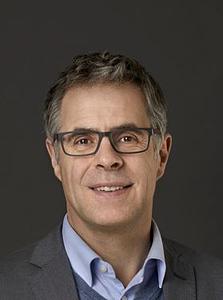
Christophe Ballif
EPFL STI IMT PV-LAB
MC A2 304 (Bâtiment MC)
Rue de la Maladière 71b, CP 526
2002 Neuchâtel 2
+41 21 695 43 36
+41 21 695 42 09
Office:
MC A2 304
EPFL › STI › IEM › PV-LAB
Website: https://pvlab.epfl.ch/
+41 21 695 43 36
EPFL › STI › STI-SMT › SMT-ENS
EPFL CEN
BAC 104 (Château de Bassenges)
Station 5
1015 Lausanne
EPFL › VPA › VPA-AVP-CP › CEN › CEN-GE
Website: https://energycenter.epfl.ch/
Expertise
Mission
Major research topics
High‑efficiency crystalline silicon solar cells
Next generation photovoltaics
Advanced detectors (fast, single photon, ...)
on innovative optical high speed detector and on various macroelectronics application. It also deals with energy management with a focus on integration of solar electricity into the energy system. The PV-Lab has strongly contributed to technology transfer and industrialization of novel devices and full technology with numerous companies.
Christophe Ballif graduated as a physicist from the EPFL in 1994, where he also obtained in 1998 his Phd degree working on novel PV materials. He accomplished his postdoctoral research at NREL (Golden, US) on compound semiconductor solar cells (CIGS and CdTe). He worked then at the Fraunhofer ISE (Ge) on crystalline silicon photovoltaics (monocrystalline and multi-crystalline) until 2003 and then at the EMPA in Thun (CH) before becoming full professor at the University of Neuchâtel IMT in 2004, taking over the chair of Prof. A. Shah.
From 2013 to end of 2026, C.Ballif has also been the initiator and the director of the CSEM Sustainable Energy Center, also located in Neuchâtel. This Center focuses on industrialisation and technology transfer in the field of solar energy, including energy management and storage. CSEM operates several "pilot lines" for various kinds of solar cells manufacturing, with advanced coating technologies, wet chemistry processes for crystalline silicon, metalisation techniques for solar cells, perovskite and tandem solar cells, as well as unique platform for developing "ideal packaging solutions and polymers" for PV modules. The joined facitilites between CSEM and EPFL of over 2000 m2 are available for poylmers modules manufacturing, measurement and accelerated aging test. Under his guidance the CSEM sustainable Energy center also pushed for the establishement of full teams and infrastructured related cated to battery storage (from front end batteries to advanced BMS systems), as well as to activities related to the grid and digitalisation of the energy systems.
He (co-) authored over 700 journal and technical papers, as well as several patents. He is an elected member of the SATW, member of the scientific council of the Swiss AEE, and member of the board of the EPFL Energy center. In 2016, he recieved the Becquerel prize for his contributions to the field of high efficiency photovoltaics.
Awards
Becquerel Prize
Commission Européenne
2016
Global Solar Scientists Award for outstanding contribution to the technological advancement of solar Energy worlwide
SNEC / China
2024
Dr. Honoris Causa
University of Ljubljana
2024
Teaching & PhD
PhD Students
Hilal Aybike Can, Jonas Lasse Diekmann, Vojtech Kliner, Tabea Krucker, Kazem Meraji, Seyedehmaryam Mirirostamkolaei
Past EPFL PhD Students
Eleonora Annigoni (2018), Luca Antognini (2022), Olatz Arriaga (2023), Rémi Biron (2013), Lionel Bloch (2020), Mathieu Boccard (2012), Alejandro Borja Block (2024), Grégory Bugnon (2013), Jean Cattin (2020), Marine Cauz (2024), Peter Cuony Bühlmann (2011), Bénédicte Demaurex (2014), Laura Ding (2013), Marina Dorokhova (2021), Julie Dreon (2022), Marion Dussouillez (2024), Lorenzo Fanni (2016), Peter Fiala (2022), Andrea Franco (2014), Samira Frey (2023), Jonas Geissbühler (2015), Luca Gnocchi (2022), Quentin Jean-Marie Armand Guesnay (2023), Simon Hänni (2014), Jordan Holweger (2021), Noémie Jeannin (2026), Thomas Andreas Lanz (2013), Hengyu Li (2013), Janina Löffler (2021), Ana Martins (2019), Gizem Nogay (2018), Ebrar Özkalay (2024), Yannick Samuel Riesen (2016), Oscar Esteban Rucavado Leandro (2019), Florent Sahli (2020), Johannes Peter Seif (2015), Laurie-Lou Senaud (2021), Karin Söderström (2013), Michael Stuckelberger (2014), Josua Andreas Stückelberger (2018), Andrea Tomasi (2016), Arttu Tuomiranta (2020), Deniz Türkay (2026), Jérémie Werner (2018), Simon Jérôme Zeder (2024)
Past EPFL PhD Students as codirector
Ezgi Genç (2024), Julien Hurni (2026), Mario Lehmann (2022)
Courses
Energy supply, economics and transition
ENG-410
This course examines energy systems from various angles: available resources, how they can be combined or substituted, their private and social costs, whether they can meet the energy demand, and how the transition to a renewable energy system can be fostered.
Fundamentals & processes for photovoltaic devices
MICRO-565
The objective of this lecture is to give an in-depth understanding of the physics and manufacturing processes of photovoltaic solar cells and related devices (photodetectors, photoconductors). The principle and techniques addressed in this lecture will be useful in a wide range of related fields.