
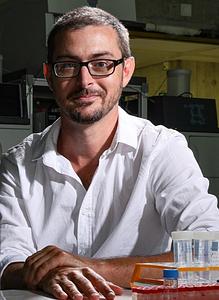
Florian Breider
EPFL ENAC IIE GR-CEL
GR A1 382 (Bâtiment GR)
Station 2
1015 Lausanne
+41 21 693 08 69
+41 21 693 80 09
Office:
GR A1 382
EPFL › ENAC › IIE › GR-CEL
Website: https://gr-cel.epfl.ch/
From 2015 to 2018, he was research scientist in the Laboratory for Water Quality and Treatment at EPFL where he conducted research on disinfection by-products and antibiotic resistant bacteria.
Since May 2018, he is director of the Central Environmental Laboratory at the Institute of Environmental Engineering of EPFL.
Education
PhD
| Stable isotope biogeochemistry
2008 – 2012
University of Neuchatel, Switzerland
Centre of Hydrogeology and Geothermics
Directed by
Prof. D. Hunkeler
MSc in Environmental geosciences
| Environmental chemistry and physics2006 – 2008 University of Lausanne, Switzerland
BSc in Chemical engineering
|2001 – 2004 University of Applied Sciences of Western Switzerland
Professionals experiences
Head of Unit
Research Scientist
Postdoctoral Research Fellow
Research Scientist
Graduate Research Assistant
Scientific Collaborator
Selected publications
Formation of N-nitrosamines by micelle-catalysed nitrosation of aliphatic secondary amines
Breider F., Salihu I., von Gunten U.
Published in Environmental Science: Processes & Impacts, 2018 in
Specific and total N-nitrosamines formation potentials of nitrogenous micropollutants during chloramination
Piazzoli A., Breider F., Gachet Aquillon C., Antonelli M., von Gunten U.
Published in Water Research 2018 in
Nitrate formation during ozonation as a surrogate parameter for abatement of micropollutants and the N-nitrosodimethylamine (NDMA) formation potential
Song Y., Breider F., Ma J., von Gunten U.
Published in Water Research 122 (2017) 246-257 in
Quantification of total N-nitrosamine concentrations in aqueous samples via UV-photolysis and chemiluminescence detection of nitric oxide
Breider F., von Gunten U.
Published in Analytical Chemistry, 2017, 89, 1574-1582 in
Insight into nitrous oxide production processes in the western North Pacific based on a marine ecosystem isotopomer model
Chisato Yoshikawa, Hitomi Abe, Maki N. Aita, Florian Breider, Keichi Kuzunuki, Sakae Toyoda, Nanako O. Ogawa, Hisami Suga, Naohiko Ohkouchi, Sebastian O. Danielache, Masahide Wakita, Makio C. Honda, Naohiro Yoshida
Published in Journal of Oceanography, 2016 in
Origin and fluxes of nitrous oxide along a latitudinal transect in western North Pacific: Controls and regional significance
Florian Breider, Chisato Yoshikawa, Hitomi Abe, Sakae Toyoda, Naohiro Yoshida
Published in Global Biogeochemical Cycles, 2015 in
Formation mechanisms of trichloromethyl-containing compounds in the terrestrial environment: A critical review
Breider F., Albers C.N.
Published in Chemophere, 2015, 119, 145-154 in
Mechanistic insights into the formation of chloroform from natural organic matter using carbon stable isotope analysis
Breider, F., Hunkeler, D.
Published in Geochimica et Cosmochimica Acta, Volume 125, 15 January 2014, Pages 85�95 in
Investigating chloroperoxidase-catalyzed formation of chloroform from humic substances using chlorine stable isotope
Breider F., Hunkeler D.
Published in Environmental Science and Technology, 2014, 48 (3), pp 1592�1600 in
Assessing the role of trichloroacetyl-containing compounds in the natural formation of chloroform using carbon stable isotopes analysis
Breider F., Albers C.N., Hunkeler D.
Published in Chemosphere, 2013, 90, 441-448 in
Demonstrating a natural origin of chloroform in groundwater using stable carbon isotopes
Hunkeler D., Laier T., Breider F., Jacobsen O.S.
Published in Environmental Science and Technology, 2012, 46, 6096-6101 in
Position-specific carbon isotope analysis of trichloroacetic acid by gas chromatography/isotope ratio mass spectrometry.
Breider F., Hunkeler D.
Published in Rapid Communication in Mass Spectrometry, 2011, 25 (24), 3659-3665 in
Unfolding the action mode of light and homogeneous vs. heterogeneous photo-Fenton in bacteria disinfection and concurrent elimination of micropollutants in urban wastewater, mediated by iron oxides in Raceway Pond Reactors
de la Obra Jiménez et al.,
Published in Applied Catalysis B: Environmental, 2019 in
Research
International conferences
N-nitrosamines in wastewater
1. What is the concentration of specific N-nitrosamines in selected industrial effluents?
2. What is the relative contribution of specific N-nitrosamines to the total N-nitrosamine pool in industrial wastewaters?
3. What is the temporal variability of the specific and total N-nitrosamines concentrations in industrial effluent?
4. Are N-nitrosamine concentrations in industrial effluents correlated with other chemical species?
Microplastics as Vectors of Environmental Contamin
possible direct adverse effects on biota, the potential role of plastics as vectors for hydrophobic organic chemicals and inorganic
materials is a topic of much debate.
To further improve the estimations of the role of plastics as vectors for toxic contaminants transfer into biota under varying environmental
conditions, it is important to identify and understand the governing processes.
Micellar catalysis
Characterization of N-nitrosamines
Scientific reports
Teaching & PhD
Past EPFL PhD Students as codirector
Courses
Pollutants analysis in the environment
ENV-300
Evaluation of the quality of a river by using methods of observation as well as physico-chemical and biological methods. Collecting samples in the field and laboratory analysis. Practical determination and use of the constants of complexes formation.
Urban dialogues: sustainability and mediation
PENS-233
This course, in partnership with HEP Vaud, deals with sustainable cities and the potential of cultural and scientific mediation. Environmental and social issues are addressed in relation to the Chamberonne River, with the aim of designing and running a mediation workshop for school classes.