
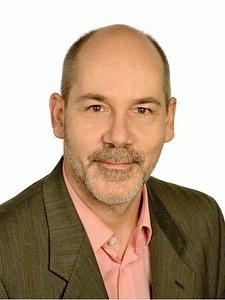
Jean-Marie Fuerbringer
EPFL SB SPH-GE
PH D1 392 (Bâtiment PH)
Station 3
1015 Lausanne
+41 21 693 30 51
Office:
PH D1 392
EPFL › SB › SB-SPH › SPH-GE
Site web: https://sph.epfl.ch/
EPFL SB SPH-GE
PH D1 392 (Bâtiment PH)
Station 3
1015 Lausanne
+41 21 693 30 51
EPFL › SB › SB-SPH › SPH-ENS
Site web: https://sph.epfl.ch/
EPFL SB SPH-GE
PH D1 392 (Bâtiment PH)
Station 3
1015 Lausanne
Expertise
Gestion des compétences
De 1995 à 1997, Il est chercheur invité au NIST à Gaithersburg (Maryland).
De 1997 à 2001 Il est professeur invité à la faculté des Sciences de L'ingénieur de l'Université Catholique de Lima(PUCP) au Pérou. Durant la même période, il fonde et dirige le Learning Center de Graña y Montero, un groupe de service d'ingénierie à Lima.
De 2001 à 2008, il rejoint le Laboratoire de Gestion et Procédés de production (LGPP) à l'EPFL comme chef de projets dans les domaines de la gestion des compétences et de la pédagogique universitaire.
De 2007 à 2010, il est l'adjoint de la Section de Génie Mécanique et depuis 2008 aussi auprès de la direction de l'Institut de Génie Mécanique.
De 2010 à 2013, il assume la charge d'adjoint du doyen de l'école doctorale (EDOC).
Depuis novembre 2013, il est collaborateur scientifique à la section de physique et chargé de cours au niveau du bachelor, du master, de l'école doctorale et du collège des sciences de l'UNIL.
Publications représentatives
Design of experiment approach applied to reducing and oxidizing tolerance of anode supported solid oxide fuel cell. Part I: Microstructure optimization
A. Faes, J.-M. Fuerbringer, D. Mohamedi, A. Hessler-Wyser and G. Caboche et al.
Published in 9th European SOFC Forum, Lucerne, SWITZERLAND, Jun 29-Jul 02, 2010. in
A fuzzy approach for the evaluation of competences
Pepiot G.; Cheikhrouhou N.; F�rbringer; J.-M.; Glardon R.
Published in International Journal of Production Economics, 2006 in
M�thodologie COMET pour une gestion Proactive des comp�tences
F�rbringer; J.-M.; Glardon R. ; Glardon F.; Pepiot G.
Published in Revue fran�aise de gestion industrielle 24(1), pp. 117-127, 2005. in
Pilot Modules of OPESS - an Online Course on Operations Management, ERP- and SCM Systems
F�rbringer, J.-M.; Glardon, R.; Nienhaus J.; M.Stammbach
Published in Proceedings of the International Conference on Engineering Education, August 18-21, 2002, Manchester, U.K. in
Confidence of simulation results: put a SAM in your model
F�rbringer J.-M., Roulet C.-A.
Published in Energy and Buildings 30, pp. 61-71, 1999 in
Comparison and combination of factorial and Monte-Carlo design in sensitivity analysis
F�rbringer J.-M., Roulet C.-A.
Published in Building and Environment, vol. 30, No. 4, pp. 505-519, 1995. in
Bayesian method for estimating airtightness coefficients from pressurisation measurement
F�rbringer J.-M., Foradini F., Roulet C.-A.
Published in Building and Environment, vol. 29, no 2, pp. 151-157, 1994. in
Technique of sensitivity analysis applied to an air infiltration multizone model
F�rbringer J.-M., Borchiellini R.
Published in ASHRAE trans., vol 99, Pt.2 DE-93-7-1, 1993. in
Study of errors occurring in measurement of leakage distribution in buildings by multifan pressurisation
F�rbringer J.-M., Roulet C.-A.
Published in Building and Environment, vol. 26, no 2, pp.111-120, 1991. in
Enseignement et PhD
Cours
Design of experiments (a) - Fall semester
ENG-606(a)
The course teaches the acquisition of a methodology of designing experiments for optimal quality of the results and of the number of experiments.
Laboratoire de physique IIIa
PHYS-319
Ce cours permet d'observer de nombreux phénomènes physiques et leur applications technologiques. Il permet ainsi d'acquérir des connaissances sur les méthodes d'observation, de mesure et d'analyse des données. Les étudiants se familiarisent avec la communication scientifique.
Laboratoire de physique IIIb
PHYS-320
Ce cours permet d'observer de nombreux phénomènes physiques et leur applications technologiques. Il permet ainsi d'acquérir des connaissances sur les méthodes d'observation, de mesure et d'analyse des données. Les étudiants se familiarisent avec la communication scientifique.
Modeling and design of experiments
PHYS-442
Dans le monde académique ou industriel, pour optimiser un système, il faut établir des stratégies pour la démarche expérimentale. Le DOE permet de choisir le meilleur set de points de mesure pour minimiser la variance des résultats. Les notions apprises sont applicables dans tous les domaines.