
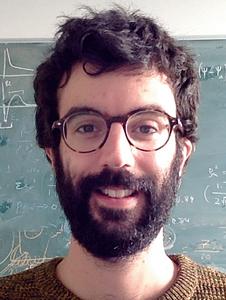
Joaquim Loizu
Nationality: Spain
EPFL SB SPC-TH
PPB 215 (Bâtiment PPB)
Station 13
1015 Lausanne
+41 21 693 65 46
Office:
PPB 215
EPFL › SB › SPC › SPC-TH
Website: https://spc.epfl.ch/
+41 21 693 87 12
EPFL › SB › SB-SPH › SPH-ENS
Website: https://sph.epfl.ch/
In 2009, he graduated in Physics at EPFL, carrying out his Master thesis project at the Center for Bio-Inspired Technology, Imperial College London, on the theoretical and numerical study of the biophysics of light-sensitive neurons.
In 2013, he obtained his PhD from EPFL and was awarded the European Physical Society Plasma Physics PhD Research Award. His thesis focused on the theory of plasma-wall interactions and their effect on the mean flows and turbulence in magnetized plasmas.
Between 2014 and 2018, he carried out postdoctoral research at the Princeton Plasma Physics Laboratory and at the Max-Planck-Institute for Plasma Physics. During this time, he worked on three-dimensional magnetohydrodynamics, studying the formation of singular currents at rational surfaces, magnetic islands, and magnetic field line chaos, and their implications for stellarators.
In 2018, he joined the Swiss Plasma Center as a Scientist and Lecturer. In 2025, he became MER (Maître d'Enseignement et Recherche) at EPFL. In 2026, he became Head of Theory at the Swiss Plasma Center.
He has been PI of the Simons Foundation project on Hidden Symmetries and Fusion Energy from (2022-2025) and PI for the European Collaboration on Stellarator Optimization funded by Eurofusion (2026-2027).
Infoscience
Research
Current Research Fields
I have played an important role in the development of a number of simulation codes (GBS for plasma fluid turbulence, SPEC and SPECTRE for stellarator equilibria, FENNECS for non-neutral plasmas, ODISEE for plasma-wall interactions). I have also played an important role in the design and operation of basic plasma physics experiments at the Swiss Plasma Center, such as the Trapped Electron Experiment T-REX or the Polaris stellarator.
Teaching & PhD
PhD Students
Erol Balkovic, Simone Barreca, Pierrick Paul Louis Giroud-Garampon, Ludovic Rais, María Teresa Ramos García, Zeno Tecchiolli
Past EPFL PhD Students as codirector
Antoine Baillod (2023), Guillaume Michel Le Bars (2023), António João Caeiro Heitor Coelho (2024)
Courses
General physics : electromagnetism
PHYS-201(a)
The topics covered by the course are concepts of electromagnetism and electromagnetic waves.
Introduction to plasma physics
PHYS-325
Introduction to plasma physics aimed at giving an overall view of the unique properties specific to a plasma. The models commonly used to describe its behavior are presented and illustrated with examples. Application to thermonuclear fusion and some astrophysical phenomena.
Magnetic confinement
PHYS-731
To provide an overview of the fundamentals of magnetic confinement (MC) of plasmas for fusion.The different MC configurations are presented, with a description of their operating regimes.The basic elements of particle & energy transport, of plasma-wall interaction & of burning plasma are introduced.