
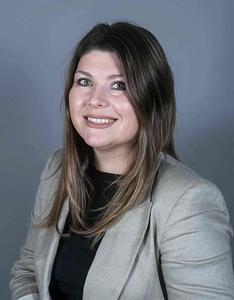
Maria Pannatier
+41 21 693 03 70
EPFL › VPA › VPA-AVP-E › AVP-E › AVP-E-LEARN
Site web: https://learn.epfl.ch
Mission
My research focuses on how people learn and teach in open, online and digital learning environments. Drawing on cognitive science, experimental learning research and educational technology, I seek to optimise online assessment and evaluation processes. Using a combination of qualitative and quantitative methods, including eye tracking, I design and evaluate evidence-based learning settings, AI-enhanced tools and professional development for teachers that support open, data-rich, high-quality education.
Dr. Maria Pannatier started her career as a language teacher and developed an interest in research related to online language learning, as well as distance and open learning. Her research focused on how technology could improve teaching and learning, and on the potential of educational technology for students and educators. She spent many years training teachers in technology-enhanced pedagogies and consulting with educational institutions on the implementation of distance learning programmes. Several university MOOCs and distance learning programmes, including Bachelor's and Master's degrees in Applied Informatics in Education, were developed under her supervision. After spending several years in the EdTech enterprise, she returned to academia, where her research focused on how people better learn and teach with technology, including instructional design, multimedia learning, video-based learning, and learning content in a second language (L2). For her PhD at TECFA UNIGE (2023), she investigated the impact of instructional aids in the form of different language video subtitles on learning in L2, within the framework of multimedia learning theories and using an eye-tracking method.
She recently joined the research team at the EPFL Center for Learning Science (LEARN), where she is working on a translational approach to digital transformation in education and teacher training, as well as on empowering teachers with digital assessment tools in collaboration with BeLEARN. Her first project, 'Monitoring for Empowering Trainers and Student Teachers in the Implementation of Digital Competencies', explored how the Digital Training Companion, powered by data science and AI, could improve the monitoring and follow-up of digital competence training among in-service teachers and their students (2023–2025). She has received cantonal funding from BeLEARN for her research on AI-supported course evaluation and teaching quality in tertiary education for the next two years - AI Beacon (2026–2027).
Maria Pannatier has extensive experience of organising international events and seminars, as well as reviewing doctoral theses, conference papers and journal articles.
She recently joined the research team at the EPFL Center for Learning Science (LEARN), where she is working on a translational approach to digital transformation in education and teacher training, as well as on empowering teachers with digital assessment tools in collaboration with BeLEARN. Her first project, 'Monitoring for Empowering Trainers and Student Teachers in the Implementation of Digital Competencies', explored how the Digital Training Companion, powered by data science and AI, could improve the monitoring and follow-up of digital competence training among in-service teachers and their students (2023–2025). She has received cantonal funding from BeLEARN for her research on AI-supported course evaluation and teaching quality in tertiary education for the next two years - AI Beacon (2026–2027).
Maria Pannatier has extensive experience of organising international events and seminars, as well as reviewing doctoral theses, conference papers and journal articles.
Publications représentatives
Learning from academic video with subtitles: When foreign language proficiency matters
M. PANNATIER, M. BETRANCOURT (2024)
Published in LEARNING AND INSTRUCTION in