
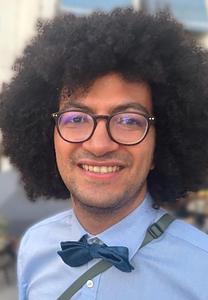
Markus Kirolos Youssef
+41 21 693 51 49
Office:
MA B3 485
EPFL › SV › BMI › UPHESS
Website: https://hessbellwald-lab.epfl.ch
Expertise
Mission
Current Work
- Ring scores: axiomatic invariants of compact metric spaces that quantify circular structure, with a stability theorem and persistence-based constructions; applications to single-cell RNA sequencing data.
- Obstructions to Quillen model structures on categories with intrinsic discrete homotopy theories via the notion of segmented categories.
Curriculum vitae
- 2026 to present: Scientist (Postdoctoral Researcher), Laboratory for Topology and Neuroscience, EPFL
- 2023 to 2026: PhD in Mathematics, EPFL (supervisor: Prof. Kathryn Hess). Thesis: On the Non-Existence of Model Structures and the Existence of Ring Scores: Two Studies in Combinatorial Topology (doi:10.5075/epfl-thesis-12216)
- 2020 to 2023: Marie Skłodowska-Curie Fellow (research software engineer, bioinformatics and cancer biology), University of Lausanne; secondment at the University of Helsinki (2022)
- 2019 to 2020: Research Intern, Barcelona Supercomputing Center / UPC
- 2016 to 2019: MSc in Geometry and Topology, University of Vienna
- 2012 to 2016: BSc in Mathematics, University of Vienna
- Languages: German and Arabic (native), English (fluent), Spanish (proficient), French (basic)
- Links: ORCID · Google Scholar · GitHub
Professionals experiences
Scientist (Postdoctoral Researcher)
Doctoral Assistant
Marie Skłodowska-Curie Fellow (Research Software Engineer, Bioinformatics and Cancer Biology)
Research Intern, Network Biology and Scientific Software
Research Intern, Signal Processing and Computer Vision
Education
Mathematics
| Thesis: On the Non-Existence of Model Structures and the Existence of Ring Scores: Two Studies in Combinatorial Topology (thesis no. 12216)
2023 – 2026
EPFL, Lausanne
Directed by
Prof. Kathryn Hess
Mathematics (Geometry and Topology)
| Thesis on ring structures in networks, the basis of the ringity package
2016 – 2019
University of Vienna
Directed by
Prof. Herbert Edelsbrunner (IST Austria) and Dr. Jörg Menche (CeMM)
Mathematics
| With a research stay at the Acoustics Research Institute of the Austrian Academy of Sciences2012 – 2016 University of Vienna
Awards
Marie Skłodowska-Curie Fellowship (Innovative Training Network, grant 859860)
European Commission
2020
Austrian Physics Olympiad, national finalist
Österreichische Physikolympiade
2012
Selected publications
On the Non-Existence of Model Structures and the Existence of Ring Scores: Two Studies in Combinatorial Topology (PhD thesis)
Markus Kirolos Youssef
Published in EPFL thesis no. 12216 in 2026
Topology identifies concurrent cyclic processes in single-cell transcriptomics and androgen receptor function
Kelly Maggs*, Markus K. Youssef*, Cyril Pulver, Jovan Isma, Tâm J. Nguyên, Matthias Arzt, Wouter Karthaus, Heather A. Harrington, Kathryn Hess, G. Paolo Dotto
Published in bioRxiv (preprint, under review); joint first author with Kelly Maggs in 2025
ANKRD1 is a mesenchymal-specific driver of cancer-associated fibroblast activation bridging androgen receptor loss to AP-1 activation
Luigi Mazzeo, Soumitra Ghosh, Emery Di Cicco, Jovan Isma, Daniele Tavernari, Anastasia Samarkina, Paola Ostano, Markus K. Youssef, Christian Simon, G. Paolo Dotto
Published in Nature Communications 15:1038 in 2024
Androgen receptor is a determinant of melanoma targeted drug resistance
Anastasia Samarkina, Markus K. Youssef, Paola Ostano, Soumitra Ghosh, Min Ma, Beatrice Tassone, Tatiana Proust, Giovanna Chiorino, Mitchell P. Levesque, Sandro Goruppi, et al.
Published in Nature Communications 14:6498 in 2023
DNA methylation sites in early adulthood characterised by pubertal timing and development: a twin study
Emir Sehovic, Stephanie M. Zellers, Markus K. Youssef, Aino Heikkinen, Jaakko Kaprio, Miina Ollikainen
Published in Clinical Epigenetics 15:181 in 2023
Probabilistic graphlets capture biological function in probabilistic molecular networks
Sergio Doria-Belenguer, Markus K. Youssef, René Böttcher, Noël Malod-Dognin, Nataša Pržulj
Published in Bioinformatics 36(Suppl. 2):i804-i812 in 2020
Research
Current Research Fields
- Applied topology and data analysis: ring scores, numerical invariants of compact metric spaces that measure how closely a space resembles a circle, built in analogy with the role of H0 persistent homology in clustering. Axioms, a stability theorem and persistence-based constructions. Applications as screening statistics for circular gene-set projections in single-cell RNA-seq data.
- Homotopy theory of discrete structures: obstructions to Quillen model structures on categories with intrinsic discrete homotopy theories, in particular x-homotopy on graphs. Various obstruction arguments extended via segmented categories to simplicial, cubical, A- and x-homotopy. Results have been formalized in Lean.