
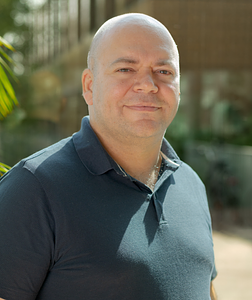
Matteo Dal Peraro
Nationality: Italian
EPFL SV IBI-SV UPDALPE
AAB 0 48 (Bâtiment AAB)
Station 19
1015 Lausanne
+41 21 693 18 61
+41 21 693 21 52
Office:
AAB 0 48
EPFL › SV › IBI-SV › UPDALPE
Website: https://lbm.epfl.ch/
+41 21 693 18 61
EPFL › SV › SV-SSV › SSV-ENS
Website: https://sv.epfl.ch/education
EPFL SV IBI-GE
AAB
Station 15
1015 Lausanne
+41 21 693 18 61
EPFL › SV › IBI-SV › IBI-SV-GE
Website: https://bioengineering.epfl.ch/
EPFL STI IBI-GE
AAB
Station 15
1015 Lausanne
+41 21 693 18 61
EPFL › STI › IBI-STI › IBI-STI-GE
Website: https://bioengineering.epfl.ch/
+41 21 693 18 61
EPFL › STI › STI-DEC › STI-DIR
+41 21 693 18 61
EPFL › SV › SV-DEC › SV-DIR
Expertise
Mission
Education
B.S. and M.S.
| Physics2000 – 2000 University of Padua
Ph.D.
| Biophysics2004 – 2004 International School for Advanced Studies (SISSA)
Infoscience
Teaching & PhD
PhD Students
Alissa Agerova, Jana Susanne Anton, Parth Bibekar, Artemiy Burov, Edoardo Cavani, Roxana Ghasemi, Marianna Mitsioni, Arthur Samurkas, Benedikt Singer, Fernando Augusto Teixeira Pinto Meireles
Past EPFL PhD Students
Martina Audagnotto (2017), Deniz Aydin (2019), Christophe Bovigny (2014), Matteo Thomas Degiacomi (2012), Giulia Fonti (2019), Benjamin Gallusser (2024), Alexandra Styliani Kalantzi (2019), Lucien Fabrice Krapp (2023), Thomas Lemmin (2013), Simon Finn Mayer (2024), Hasan Pezeshgi Modarres (2015), Alessio Prunotto (2020), Enrico Spiga (2013), Giorgio Elikem Tamo (2018), Anastasia Theodoropoulou (2024), Sylvain Träger (2021), Zhidian Zhang (2024)
Past EPFL PhD Students as codirector
Maiia Bragina (2020), Michel Plattner (2018), Verena Rukes (2026)
Courses
Scientific literature analysis in computational molecular biology
BIO-468
The goal of this course is to learn to analyze a scientific paper critically, asking whether the data presented support the conclusions that are drawn. The analysis is presented in the form of a summary presentation and critical, constructive assessments of the paper.
Structural biology
BIO-315
The main focus of this course is on the molecular interactions defining the structure, dynamics and function of biological systems. The principal experimental and computational techniques used in structural biology, as well as molecular modeling and design will be introduced and practiced.