
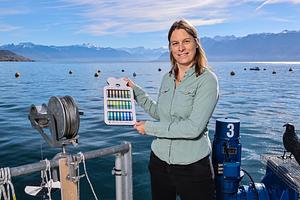
Natacha Pasche
EPFL ENAC LIMNC
GR A2 435 (Bâtiment GR)
Station 2
1015 Lausanne
+41 21 693 59 43
Office:
GR A2 435
EPFL › ENAC › LIMNC › LIMNC-GE
Website: https://limnc.epfl.ch/
Expertise
- High-frequency lake monitoring
- Lake particle dynamics and sedimentation processes
- Management and operation of high-tech research infrastructures
- Design and implementation of citizen-science projects
- Data management and FAIR/Open Research Data practices
- Multidisciplinary project coordination and international scientific collaboration
- Teaching and mentoring in limnology and freshwater sciences
- Active member in national and international committees for lake management
Mission
Current work
In addition to my operational and research activities, I contribute to national and international committees, providing scientific guidance and advice on lake monitoring, ecosystem management, and research coordination.
Education
Environmental Engineer
| Master degree
1999 – 2004
EPFL
Directed by
Master's thesis: Effect of flooded rice cultivation on a vertisol in the Middle Senegal River Valley – evolution of iron, potassium forms, and mineralogy. Student assistant for mathematics and physics courses (2000–2003), supporting undergraduates
PhD: Limnology
| Nutrient cycling and methane production in Lake Kivu
2006 – 2009
Eawag and ETHZ
Directed by
Dissertation conducted at Eawag with extensive fieldwork in Rwanda and DR Congo. Awarded Price of Excellence from the Swiss Foundation for Hydrobiology – Limnology.
Professionals experiences
Operational Director of the Limnology Center
Deputy Director of the Limnology Center
Deputy Director of the Swiss Polar Institute
Expert in Limnology
Awards
Price of Excellence for outstanding PhD research
Swiss Foundation for Limnology and Hydrobiology
2009
Research
Current Research Fields
Lémanscope: Citizen-science project engaging the public in lake observation and environmental awareness through participatory data collection.
SEDTRAP and LakeSnow: Scientific projects conducted on LéXPLORE focusing on lake particle dynamics, sedimentation processes, aggregation of particles within the Rhône interflow.
FLAKE : Advancing FAIR and Open Research Data practices to improve data pipelines and data quality of LéXPLORE datasets.
Peer-reviewed publications
Carratalà, A. and others. 2023. Vertical distribution and seasonal dynamics of planktonic cyanobacteria communities in a water column of deep mesotrophic Lake Geneva. Front. Microbiol. 14: 1295193. doi:10.3389/fmicb.2023.1295193
Escoffier, N., P. Perolo, G. Many, N. Tofield Pasche, and M.-E. Perga. 2023. Fine-scale dynamics of calcite precipitation in a large hardwater lake. Science of The Total Environment 864: 160699. doi:10.1016/j.scitotenv.2022.160699
Fabrice Amisi, M. and others. 2022. Current status and strategic way forward for long-term management of Lake Kivu (East Africa). Journal of Great Lakes Research. doi:10.1016/j.jglr.2022.04.004
Plisnier, P.-D. and others. 2022. Need for harmonized long-term multi-lake monitoring of African Great Lakes. Journal of Great Lakes Research. S0380133022000326. doi:10.1016/j.jglr.2022.01.016
Wüest, A., D. Bouffard, J. Guillard, B. W. Ibelings, S. Lavanchy, M.-E. Perga, and N. Pasche. 2021. LéXPLORE: A floating laboratory on Lake Geneva offering unique lake research opportunities. WIREs Water 8: e1544. doi:10.1002/wat2.1544
Chmiel, H. E., H. Hofmann, S. Sobek, T. Efremova, and N. Pasche. 2020. Where does the river end? Drivers of spatiotemporal variability in CO2 concentration and flux in the inflow area of a large boreal lake. Limnol Oceanogr 65: 1161–1174. doi:10.1002/lno.11378
Alfred Wüest, Natacha Pasche, Bastiaan Ibelings, Sapna Sharma and Nikolay Filatov (2019): Life under Ice in Lake Onego (Russia) & An Interdisciplinary Winter Limnology Study. Inland Waters 9 (2), editorial.
Natacha Pasche, Hilmar Hofmann, Damien Bouffard, Carsten J. Schubert, Petr A. Lozovik, Sebastian Sobek (2019): Implications of river intrusion and convective mixing on the spatial and temporal variability of under-ice CO2. Inland Waters 9 (2) in Life under Ice in Lake Onego (Russia) & An Interdisciplinary Winter Limnology Study.
Camille Thomas, Victor Frossard, Marie-Elodie Perga, Natacha Tofield-Pasche, Hilmar Hofmann, Nathalie Dubois, Natalia Belkina, Mariya Zobkova, Serge Robert, Emilie Lyautey (2019): Lateral variations and vertical structure of the microbial methane cycle in the sediment of Lake Onego (Russia), Inland Waters 9 (2) in Life under Ice in Lake Onego (Russia) & An Interdisciplinary Winter Limnology Study.
Tatyana A. Efremova, Albina V. Sabylina, Petr A. Lozovik, Vera I. Slaveykova, Maria V. Zobkova and Natacha Pasche (2019): Seasonal and spatial variation in hydrochemical parameters in Lake Onego (Russia): insights from 2016 field monitoring, Inland Waters 9 (2) in Life under Ice in Lake Onego (Russia) & An Interdisciplinary Winter Limnology Study.
Damien Bouffard, Roman E. Zdorovennov, Gallina E. Zdorovennova, Natacha Pasche, Alfred Wüest and Arkady Y. Terzhevik (2016): Ice-covered Lake Onega: effects of radiation on convection and internal waves; Hydrobiologia. DOI: 10.1007/s10750-016-2915-3.
Pasche Natacha, Tuyisenge Janvière, Mugisha Ange, Rugema Edouard, Muzana Alice, Uwasempabuka Aline and Umutoni Augusta (2015). Building Local Capacities to Monitor Methane Extraction in Lake Kivu, pp 235-244. Chapter 21 in Hostettler, Silvia, Gadgil, Ashok, Hazboun, Eileen (Eds) Sustainable Access to Energy in the Global South, DOI 10.1007/978-3-319-20209-9_21, © Springer International Publishing
Fabrice A. Muvundja, Alfred Wüest, Mwapu Isumbisho, Mwenyemali B. Kaningini, Natacha Pasche, Päivi Rinta, Martin Schmid (2014): Modelling Lake Kivu water level variations over the last seven decades. Limnologica Ecology and Management of Inland Waters 47, p 21&33, doi:10.1016/j.limno.2014.02.003.
Natacha Pasche, Fabrice Muvundja, Martin Schmid, Alfred Wüest, and Beat Müller (2012): Nutrient cycling in Lake Kivu, p 31 - 45. Chapter 3 in J.-P. Descy et al. (eds.), Lake Kivu: Limnology and biogeochemistry of a tropical great lake, Aquatic Ecology Series 5, DOI 10.1007/978-94-007-4243-7_3, © Springer Science Business Media B.V. 2012.
Natacha Pasche (2012): Paleolimnology of Lake Kivu: past climate and recent environmental changes, p 153 - 163. Chapter 9 in J.-P. Descy et al. (eds.), Lake Kivu: Limnology and biogeochemistry of a tropical great lake, Aquatic Ecology Series 5, DOI 10.1007/978-94-007-4243-7_9, © Springer Science Business Media B.V. 2012.
Alfred Wüest, Lukas Jarc, Helmut Bürgmann, Natacha Pasche and Martin Schmid (2012): Methane formation and future extraction in Lake Kivu, p 165 - 180. Chapter 10 in J.-P. Descy et al. (eds.), Lake Kivu: Limnology and biogeochemistry of a tropical great lake, Aquatic Ecology Series 5, DOI 10.1007/978-94-007-4243-7_10, © Springer Science Business Media B.V. 2012.
Natacha Pasche, Martin Schmid, John Kessler, Mary Pack, Bill Reeburgh, Carsten Schubert, Francisco Vazquez and Helmut Bürgmann (2011): Methane sources and sinks in Lake Kivu. Journal of Geophysical Research 116, G03006.N
Natacha Pasche, Georges Alunga, Keely Mills, Fabrice Muvundja, David B. Ryves, Michael Schurter, Bernhard Wehrli and Martin Schmid (2010): Abrupt onset of carbonate deposition in Lake Kivu during the 1960s: response to recent environmental changes.Journal of Paleolimnology 44, 931-946.
Natacha Pasche (2009): Nutrient cycling and methane production in Lake Kivu, thesis es science, 127pp, ETH No.18606, Zürich.
Natacha Pasche, Christian Dinkel, Beat Müller, Martin Schmid, Alfred Wüest and Bernhard Wehrli (2009): Physical and biogeochemical limits to internal nutrient loading of meromictic Lake Kivu. Limnology and Oceanography 54, 1863-1873.
Fabrice Muvundja, Natacha Pasche, Fred W. B. Bugenyi, Mwapu Isumbisho, Beat Müller, Jean-Népomuscène Namugize, Päivi Rinta, Martin Schmid, Ruth Stierli and Alfred Wüest (2009): Balancing nutrient inputs to Lake Kivu. Journal of Great Lakes Research 35, 406-415.
Sebastian Sobek, Durisch-Kaiser Edith, Zurbrügg Roland, Nuttakan Wongfun, Martin Wessels, Natacha Pasche, and Bernhard Wehrli (2009), Organic carbon burial efficiency in lake sediments controlled by oxygen exposure time and sediment source. Limnology and Oceanography 54, 2243-2254.
Mathias Kneubühler, Toni Frank, Tobias Kellenberger, Natacha Pasche and Martin Schmid (2007): Mapping chlorophyll-a in Lake Kivu with remote sensing methods. European Space Agency, (Special Publication) ESA SP (SP-636).
Teaching & PhD
Courses
Limnology
ENV-425
Focus is on lakes, rivers and reservoirs as aquatic systems. Specific is the quantitative analyse (incl. exercises) of physical, biogeochemical and sedimentological processes. The goal is to understand the relevant processes for the water quality from an engineering perspective