
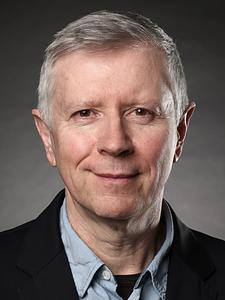
Paul Dyson
EPFL SB ISIC LCOM
BCH 2402 (Batochime UNIL)
Av. F.-A. Forel 2
1015 Lausanne
+41 21 693 98 54
+41 21 693 79 11
Office:
BCH 2402
EPFL › SB › ISIC › LCOM
Website: https://lcom.epfl.ch
+41 21 693 98 54
+41 21 693 79 11
EPFL › SB › SB-DEC › CF-SB
Website: https://sb.epfl.ch/conseil
+41 21 693 79 11
+41 21 693 98 54
EPFL › VPA › VPA-AVP-DLE › AVP-DLE-EDOC › EDMS-ENS
Website: https://go.epfl.ch/edms
Awards
Werner Prize
Swiss Chemical Society
2004
Award for Outstanding Achievements in Bioorganometallic Chemistry
2010
Centennial Luigi Sacconi Medal
Italian Chemical Society
2011
Bioinorganic Chemistry Award
Royal Society of Chemistry
2015
European Sustainable Chemistry Award
European Chemical Society
2018
Fellow of the Royal Society of Chemistry
2010
Alliance Prize
Best invention of the EPFL
2007
Fellow of the European Academy of Sciences
2019
Green Chemistry Award 2020
Royal Society of Chemistry
2020
Teaching & PhD
PhD Students
Tiziano Agostino Caldara, Lianghui Li, Aleksandar Mihaylov Mikov, Matilde Onofri, Shun Tian
Past EPFL PhD Students
Kedar Ashok Abhyankar (2023), Wee Han Ang (2007), Lucinda Kate Batchelor (2019), Ilaria Biondi (2011), Felix Daniel Bobbink (2018), Adrian Benjamin Chaplin (2007), Catherine Clavel (2014), Corinne Daguenet (2006), Antoine Dorcier (2006), Ryan Dykeman (2011), Lindsey Frederiksen (2025), Aswin Gopakumar (2018), Mouna Hadiji (2023), Yameng Hao (2023), Martin Hulla (2019), Alena Karakulina (2016), Pui Shan Genevieve Lau (2015), Wei-Tse Lee (2022), Fook Seng Ronald Lee (2016), Valentin Michael Manzanares (2016), Séverine Joëlle Moret (2014), Antoine Philippe Van Muyden (2020), Anna Katherine Renfrew (2010), Jan Romano de Gea (2025), Jaques-Christopher Schmidt (2025), Claudine Scolaro (2007), Erfan Shirzadi (2021), Serhii Shyshkanov (2020), Sviatlana Siankevich (2016), Irina Sinenko (2023), Po-Jen Tseng (2022), Dmitry Vasilyev (2019), Ana Vidis (2007), Xunhui Wang (2025), Xinbang Wu (2025), Dongbin Zhao (2006)
Past EPFL PhD Students as codirector
Oliver Anthony Beswick (2017), Lu Chen (2021), Céline Fellay (2008)
Courses
Preparative chemistry I
CH-220
Apply basic reactivity in organic chemistry to the multi-step synthesis of polyfunctional molecules. Instruction on safety regulation in laboratories of chemical synthesis. Instruction on the planification and monitoring of simple synthetic pathways.