
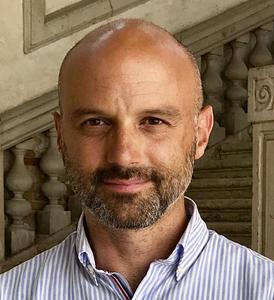

Frédéric Kaplan
EPFL CDH DHI DHLAB
INN 141 (Bâtiment INN)
Station 14
1015 Lausanne
+41 21 693 02 53
+41 21 693 19 01
Office:
INN 141
EPFL › IC › IINFCOM › DHLAB
Website: https://dhlab.epfl.ch
+41 21 693 02 53
Office:
INN 141
EPFL › VPA › VPA-AVP-DLE › AVP-DLE-EDOC › EDDH-GE
Website: https://go.epfl.ch/phd-eddh
+41 21 693 02 53
Office:
INN 141
EPFL › VPA › VPA-AVP-DLE › AVP-DLE-EDOC › CDOCT
Expertise
Expertise
Short biography
He is the author of a dozen books, translated into several languages, and more than a hundred scientific publications. His work has also been exhibited in several major museums, including the Venice Architecture Biennale, the Grand Palais, the Centre Pompidou in Paris and the Museum of Modern Art in New York.
Teaching & PhD
PhD Students
Tommy Bruzzese, Ziyi Liu, Alexander Michael Rusnak
Past EPFL PhD Students
Cyril Bornet (2017), Vincent Buntinx (2017), Giovanni Colavizza (2018), Félicien Goguey (2022), Paul Guhennec (2025), Sven Najem-Meyer (2025), Rémi Petitpierre (2025), Dario Rodighiero (2018), Benoît Laurent Auguste Seguin (2018), Beatrice Vaienti (2025)
Past EPFL PhD Students as codirector
Khaled Bachour (2010), Quentin Bonnard (2012), Andrea Mazzei (2013)
Courses
Digital humanities
HUM-369
This course explores how the Humanities are being transformed in the age of AI and big data. Each session focuses on the future of a specific discipline (history, philosophy, art history). Students develop a digital prototype (Vibe coding) to accelerate research and training in SHS.
Foundations of digital humanities
DH-405
This course introduces the core concepts and methodologies of Digital Humanities, integrating both theoretical and practical perspectives. Students learn to work with large-scale cultural datasets, acquiring the tools and techniques required for their processing, analysis, and interpretation.
Urban digital twins
URB-410
This course explores urban digital twins through theory and hands-on modeling. Students build dynamic models integrating real-time, historical, and predictive data. A project on the EPFL campus using real data serves as the case study.