
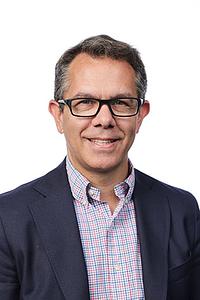
Pascal Miéville

EPFL SB ISIC SWISSCAT
CH A2 474 (Bâtiment CH)
Station 6
1015 Lausanne

2025

[20] The 2D-drone swarm, a safe open-source sample transfer system for laboratory full automation

E. MarianoY. CodereyY. E. GoumiJ. TanT. Cavagna  et al.

2025

[19] Polycondensation as a Universal Method for Preparing High-density Single-atom Catalyst Libraries

J.-C. SchmidtJ. Romano-deGeaD. C. StoianM. MensiM. Chang  et al.

ADVANCED MATERIALS. 2025. DOI : 10.1002/adma.202507627.

[18] The 2D-drone swarm, a safe open-source sample transfer system for fully automated laboratories

E. MarianoY. CodereyY. El GoumiJ. TanT. Cavagna  et al.

Digital Discovery. 2025. DOI : 10.1039/d5dd00342c.

[17] A FAIR research data infrastructure for high-throughput digital chemistry

A. GauthierL. VancauwenbergheJ.-C. CoustyC. Matthey-DoretR. Franken  et al.

Digital Discovery. 2025. DOI : 10.1039/d5dd00297d.

2024

[16] GLAS: an open-source easily expandable Git-based scheduling architecture for integral lab automation

J. C. CoustyT. CavagnaA. SchmidtE. MarianoK. Villat  et al.

Digital Discovery. 2024. DOI : 10.1039/d4dd00253a.

[15] Substance preparation method of capsules and system

E. MarianoP. MiévilleF. de NanteuilM. Kunze

WO2024134396 . 2024.

[14] An apparatus and a method for sealing an opening in a small tubular vessel

P. MiévilleK. M. Villat

EP4385710 . 2024.

[13] Materials science experiments by robotic automation

V. Scamarcio

Lausanne, EPFL, 2024. DOI : 10.5075/epfl-thesis-11140.

2023

[12] Swiss CAT plus , a Data-driven Infrastructure for Accelerated Catalysts Discovery and Optimization

P. LaveilleP. MievilleS. ChatterjeeE. ClercJ.-C. Cousty  et al.

Chimia. 2023. DOI : 10.2533/chimia.2023.154.

2022

[11] Development of metal-organic frameworks based on N-heterocyclic ligands

I. Kochetygov

Lausanne, EPFL, 2022. DOI : 10.5075/epfl-thesis-8662.

2021

[10] MAS NMR Studies of Hierarchical Interplay in Protein Dynamics

B. Busi

Lausanne, EPFL, 2021. DOI : 10.5075/epfl-thesis-8172.

2020

[9] Synthesis and characterization of iron-clathrochelates and their applications in materials science

J. L. Bila

Lausanne, EPFL, 2020. DOI : 10.5075/epfl-thesis-10001.

[8] Copper battery for heat to power conversion and energy storage

S. I. Maye

Lausanne, EPFL, 2020. DOI : 10.5075/epfl-thesis-7341.

2019

[7] Photoredox-Catalyzed Decarboxylation for the Transfer of Alkynes and Nitriles Using Hypervalent Iodine Reagents

F. Le Vaillant

Lausanne, EPFL, 2019. DOI : 10.5075/epfl-thesis-9212.

[6] Application of Hypervalent Iodine Reagents for Novel Cysteine Labeling

R. G. Tessier

Lausanne, EPFL, 2019. DOI : 10.5075/epfl-thesis-9119.

[5] Functionalization of second harmonic generation nanoparticles for theranostic applications

J. Vuilleumier

Lausanne, EPFL, 2019. DOI : 10.5075/epfl-thesis-7330.

[4] Molecular nanostructures based on polyfunctional clathrochelate complexes

S. M. Jansze

Lausanne, EPFL, 2019. DOI : 10.5075/epfl-thesis-9362.

2018

[3] MOF-Derived Cobalt Phosphide/Carbon Nanocubes for Selective Hydrogenation of Nitroarenes to Anilines

S. YangL. PengE. OveisiS. BulutD. T. Sun  et al.

Chemistry - A European Journal. 2018. DOI : 10.1002/chem.201705400.

[2] Development of functionalized alginate-based hydrogels to reduce fibrosis in the transplantation of microencapsulated cells

F. R. P. Noverraz

Lausanne, EPFL, 2018. DOI : 10.5075/epfl-thesis-8949.

[1] Hydrogen storage in the carbon dioxide/formic acid system, using homogeneous iron(II)-phosphine catalysts in aqueous solution

M. Montandon-Clerc

Lausanne, EPFL, 2018. DOI : 10.5075/epfl-thesis-8594.

Enseignement et PhD

Doctorant·es actuel·les

Leander Choudhury

Cours

Automated and data-driven laboratories

CH-400

Dans ce cours, enseigné par des experts du Swiss CAT+ West Hub, les étudiants seront initiés aux concepts clés de l'automatisation et de la chimie basée sur les données. A l'aide de cas concrets, les étudiants apprendront les compétences nécessaires à l'automatisation d'un laboratoire.

Structural analysis

CH-314

L'objectif de ce cours est de traiter les trois principales techniques de caractérisation structurale de molécules en chimie et génie chimique: la spectrométrie de masse, la RMN et les techniques à rayons X.