
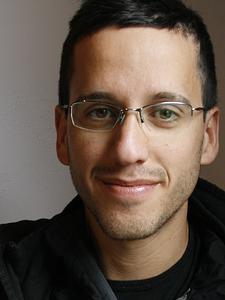
Fabrizio Sossan
Nationality: Italian
Website: https://desl-pwrs.epfl.ch
Expertise
Mathematical Modelling, Forecasting and Optimization for Power System Applications
Current work
He is currently working on (i) forecasting of the electrical load in application to real-time control of micro-grids and (ii) planning and development of the power system infrastructure under an increased penetration of distributed generation.
Fabrizio is an Italian citizen and was born in Genova on 9th April 1985. He got his B.Sc. and M.Sc. in Computer Engineering from the University of Genova in 2007 and March 2010. In 2009, he was student researcher at the University of Strathclyde (Glasgow UK) investigating on virtual inertia response of wind turbines.
In 2014, he obtained his Ph.D. from the Danish Technical University, (Department of Electrical Engineering, DTU Elektro) with the thesis Indirect control of flexible demand for power system applications (link), under the supervision of Senior Scientist H. Bindner. In the thesis, the potential of indirectly controlled demand response to support the operation of the future power system has been investigated. The thesis was approved by Prof. Dr. G.Andersson (ETHZ), Prof. Dr. M.F.Anjos (école Polytechnique de Montréal), Prof. Dr. P.Pinson (DTU).
Since the second half of 2014 he is at EPFL and works under the supervision of Prof. Dr. Mario Paolone.
Since 2016, he is co-leading the work package Forecasting of local distributed generation in the Swiss Competence Center for Energy Research- Future Swiss Electrical Infrastructure (SCCER-FURIES).
Teaching & PhD
PhD Students
Past EPFL PhD Students as codirector
Rahul Gupta (2023), Yihui Zuo (2021)
Courses
Energy storage in power systems: technologies, applications and future needs
EE-466
This course reviews the main energy storage technologies, their attributes, mathematical models, and applications (stationary and mobile), from design to operations and control. Battery systems, whose application and development rates today are among the most relevant, will be given special focus.