
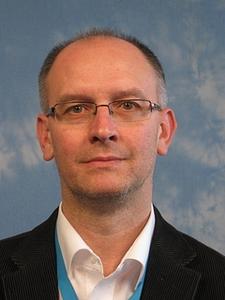
Mihai Adrian Ionescu
Nationality: Swiss and Romanian
EPFL STI IEL NANOLAB
ELB 335 (Bâtiment ELB)
Station 11
1015 Lausanne
+41 21 693 39 78
+41 21 693 39 79
Office:
ELB 335
EPFL › STI › IEM › NANOLAB
Website: https://nanolab.epfl.ch/
+41 21 693 39 78
Office:
ELB 335
EPFL › VPA › VPA-AVP-DLE › AVP-DLE-EDOC › EDMI-ENS
+41 21 693 39 78
Office:
ELB 335
EPFL › STI › STI-DEC › STI-DO
Website: https://sti.epfl.ch/page-1740.html
Expertise
Nanotechnology
Steep-slope tunnel FETs and ferroelectric FETs
Energy efficient nanoelectronics for sustainability
Qubits for Quantum Computing
Edge AI sensors
Modeling and Simulation of Solid-State Electronic Devices
Lab On Skin Technology for Digital twins
Expertise
Nanotechnology
Steep-slope tunnel FETs and ferroelectric FETs
Energy efficient nanoelectronics for sustainability
Qubits for Quantum Computing
Edge AI sensors
Modeling and Simulation of Solid-State Electronic Devices
Lab On Skin Technology for Digital twins
Mission
Current work
The Milli-Tech proposal aims at a novel technology platform serving both computation and sensing: electronic switch architectures, called steep slope switches, exploiting new device physics and concepts in emerging 2D materials to achieve operation at voltages below 100 millivolts. The project develops a technological platform called ‘millivolt technology' focusing on low power digital and sensing/analog electronic functions exploiting steep slopes, with the goal of lowering the energy per useful function (computed and sensed bit of information) by a factor of 100x.
Such ultra-low operation voltage will contribute to solving major challenges of nanoelectronics such as power issues and it will enable energy efficient super-sensitive sensors for Internet-of-Everything (IoE). Milli-Tech includes fundamental research on new solid-state steep slope device concepts: heterostructure tunnel FETs in 2D Transition-Metal-Dichalcogenides (TMD), 2D Van der Waals super-lattice energy filter switch and hybrid architectures combining two switching principles: band-to-band-tunneling and metal-insulator-transition or negative capacitance in VO2, used as additive technology boosters.
DIGIPREDICT FET Proactive Project (https://ec.europa.eu/newsroom/horizon2020/items/699059)
- DIGIPREDICT proposes the first of its kind digital twin to predict the progression of disease and the need for early intervention in infectious and cardiovascular diseases. A digital twin is a digital representation of an object or process from the real world in the digital world & and more specifically for the case of DIGIPREDICT & of a patient. The project combines the latest advances in digital biomarkers, organ-on-chip (OoC) and artificial intelligence at the edge, and aims to build a new interdisciplinary community in Europe focused on digital twins.
The developed system will provide medical doctors with a unique digital tool for early prediction of potential serious complications in COVID-19 patients. Beyond COVID-19, the system promises to also improve the prevention, diagnosis, monitoring and treatment of cardiovascular disease and detect the potential onset of inflammatory disease.
This multi- and cross-disciplinary project will combine scientific excellence with engineering know-how, and leverage the expertise of doctors, biologists, electrical engineers, computer scientists, signal-processing engineers and social scientists from across Europe .
SINERGIA NEMO Project - The NeMO (neuromimetic metal-oxide memristors) Sinergia project aims to develop fundamental understanding, optimized materials and novel device architectures for the engineering of highly tunable metal-oxide neuromimetic memristors. Mimicking biological neurons, the devices that we will develop will operate in voltage (100 to 200mV peak-to-peak) and frequency (0.1KHz to 1 MHz) ranges that will make them 100x more energy efficient than today's equivalent CMOS-based hardware. They will therefore enable implementation of highly energy efficient neuro-mimetic computational hardware for next generation information technologies.
This ambitious goal needs a multidisciplinary approach combining theoretical and computational material science, solid-state physics and chemistry, and electronic device and circuit design and technology. These synergies are reflected in the collaboration between the teams led by Professors Nicola Spaldin (Materials Department, ETHZ) and Adrian Ionescu (Electrical Engineering Department, EPFL).
Awards
The Annual Award of The Technical Section of the Romanian Academy of Sciences
Contributions to SOI technology
1994
Blondel Medal
For contributions to the progress in engineering sciences in the domain of electronics
2009
IBM Faculty Award
Engineering
2013
IEEE EDL George Smith Award
IEEE
2017
IEEE Technical Field Award Cledo Brunetti
“for leadership and contributions to the field of energy-efficient steep slope devices and technologies.â€
2024
2024 IEEE Cledo Brunetti Award
IEEE
2023
Selected publications
Tunnel field-effect transistors as energy-efficient electronic switches
A.M. Ionescu, H. Riel
Published in Nature in
Infoscience
Teaching & PhD
PhD Students
Ehsan Ansari, Onofrio Davide Caputo, Vanessa Conti, Siddharth Gautam, Ali Gilani, Benoît Valentin Hirtzel, Andrea Iaconeta, Tú Anh Lê, Niccolo Martinolli, Cyrille Masserey, Emi Myzeqari, Shima Rezaee Fakhr, Zahra Saadat Somaehsofla, Lotte Franciska N De Schrijver, Edoardo Tenna, Ketong Yang, Amirhossein Zahedi, Yann Zosso
Past EPFL PhD Students
Nicolas Abelé (2007), Donatello Acquaviva (2010), Cem Alper (2017), Costin Anghel (2004), Anupama Arun (2010), Sebastian Thimotee Bartsch (2013), Francesco Bellando (2020), Fabio Bersano (2025), Jyotshna Bhandari (2011), Arnab Biswas (2015), Matthieu Bopp (2011), Katherine Boucart (2010), Elizabeth Buitrago Godinez (2014), Ji Cao (2013), Luca Capua (2023), Emanuele Andrea Casu (2018), Nicoleta-Diana Ciressan (2009), Clarissa Convertino (2020), Elisabetta Corti (2021), Davide Cutaia (2016), Nenad Cvetkovic (2011), Nilay Dagtekin (2015), Serge Ecoffey (2007), Montserrat Fernandez-Bolanos Badia (2010), Raphaël Fritschi (2007), Erick Antonio Garcia Cordero (2018), Carlotta Gastaldi (2022), Hesham Ghoneim (2012), Daniel Grogg (2010), Hoël Maxime Guérin (2014), Nasser Hefiana (2005), Marion Hermersdorf (2013), Sadegh Kamaei Bahmaei (2023), Livio Lattanzio (2013), Hung-Wei Li (2025), Santanu Mahapatra (2005), Mariazel Maqueda López (2017), Alexander Mehdaoui (2007), Luca De Michielis (2012), Clara-Fausta Moldovan (2016), Negar Moridi (2015), Kirsten Emilie Moselund (2008), Mohammad Najmzadeh (2012), Nicolò Oliva (2020), Marcelo Bento Pisani (2007), Vincent Pott (2008), Fatemeh Qaderi Rahaqi (2022), Sara Rigante (2014), Teodor Rosca (2022), Maneesha Rupakula (2020), Alexandru Rusu (2012), Ali Saeidi (2019), Giovanni Antonio Salvatore (2011), Pankaj Sharma (2015), Yann Christophe Sprunger (2025), Wolfgang Amadeus Vitale (2016), Junrui Zhang (2019)
Past EPFL PhD Students as codirector
Yogesh Singh Chauhan (2007), Michele Tamagnone (2016)
Courses
Aspects of quantum science and sustainability
QUANT-411
We explore the intersection of quantum technologies and sustainability. Topics: 1)discussions of fundamental aspects of thermodynamics of computation; 2)analysis and benchmarks of energy consumption in current and near term real quantum devices; 3)projects on use cases through personal student work.
Beyond CMOS devices and advanced computing architectures
MICRO-727
This course provides the trends in nanoelectronics for scaling, better performances and lower energy per function. It covers fundamental phenomena of nanoscale devices, beyond CMOS steep slope switches, emerging architectures, cryo electronics, non-volatile memories and energy efficient smart sensin
Nanoelectronics
EE-535
This lecture overviews and discusses the last trends in the technology and principles of nanoelectronic devices for more aggressive scaling, better performances, added functionalities and lower energy per function. The opportunities of these advances compared to industrial roadmaps are analized.
Semiconductor devices II
EE-567
Students will learn about understanding the fundamentals and applications of emerging nanoscale devices, materials and concepts. Remark: at least 5 students should be enrolled for the course to be given
Wearables and implantables for personalized and preventive healthcare
MICRO-624
This multidisciplinary course presents, from both engineering and medical perspectives, the state-of-the-art, applications and impact of wearable and implantable technologies, with focus on cardiovascular healthcare shift from intervention-based to personalized and preventive medical strategies.