
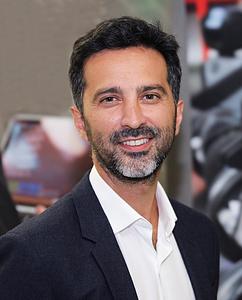
Alexandre Alahi
EPFL ENAC IIC VITA
GC C1 383 (Bâtiment GC)
Station 18
1015 Lausanne
+41 21 693 26 08
Office:
GC C1 383
EPFL › ENAC › IIC › VITA
Website: https://vita.epfl.ch/
EPFL ENAC IIC VITA
GC C1 383 (Bâtiment GC)
Station 18
1015 Lausanne
+41 21 693 26 08
Office:
GC C1 383
EPFL › VPA › VPA-AVP-DLE › AVP-DLE-EDOC › EDCE-ENS
Expertise
Mobility
Computer Vision
Machine Learning
Deep Learning
Human-Robot Interaction
Socially-aware Artificial Intelligence
Ambient Intelligence
His research lies at the intersection of Computer Vision, Machine Learning, and Robotics applied to transportation & mobility. To make Artificial Intelligence (AI) driven systems such as autonomous vehicles a safe reality, his lab works on a new type of Artificial Intelligence (AI), namely socially-aware AI, i.e., an AI augmented with social intelligence.
In 2022&2023, Alexandre was recognized as one of the top 100 Most Influential Scholar in Computer Vision over the past 10 years.
His research team received the editor's choice award from the journal Image and vision computing (2021) for their work on human motion prediction, the honorable mention at an ICCV workshop (2019) for their work on human pose estimation,
the CVPR Open Source Award (2012) for their work on Retina-inspired image descriptors, and the ICDSC Challenge Prize (2009) for their sparsity-driven algorithm that has tracked more than 100 million pedestrians to date.
His work has been licensed to several companies and covered internationally by BBC, abc, PBS, Euronews, Wall street journal, and other national news outlets around the world. Alexandre has also co-founded multiple startups such as Visiosafe, and won several startup competitions. He was elected as one of the Top 20 Swiss Venture leaders in 2010.
Awards
CVPR Open Source Award
0
ICDSC Challenge Prize
0
AI 100 Most Influential Scholar Honorable Mention in Computer Vision
2022
AI 2000 Most Influential Scholar Honorable Mention
2022
Infoscience
Research
Research summary
Teaching & PhD
PhD Students
Mohamed Ossama Ahmed Abdelfattah, Yasamin Borhani, Bastien Van Delft, Lan Feng, Yang Gao, Valentin Gerard, Yasaman Haghighi, Mariam Hassan, Reyhaneh Hosseininejad, Po-Chien Luan, Ahmad Rahimi, Parsa Rahimi Noshanagh, Megh Shukla, Weijiang Xiong
Past EPFL PhD Students
George Adaimi (2022), Mohammadhossein Bahari (2024), Melika Behjati (2024), Lorenzo Bertoni (2022), Parth Ashit Kothari (2022), Yuejiang Liu (2023), Saeed Saadatnejad (2023), Brian Alan Tappy-Sifringer (2024)
Past EPFL PhD Students as codirector
Courses
Frontiers of Deep Learning for Engineers
CIVIL-611
The seminar aims at discussing recent research papers in the field of deep learning, implementing the transferability/adaptability of the proposed approaches to applications in the field of research of the Ph.D. student.