
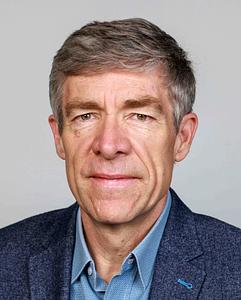
Philippe Thalmann
Nationality: Swiss
EPFL ENAC IA LEURE
BP 2137 (Bâtiment BP)
Station 16
1015 Lausanne
+41 21 693 73 21
Office:
BP 2137
EPFL › ENAC › IA › LEURE
Website: https://leure.epfl.ch
+41 21 693 73 21
EPFL › ENAC › ENAC-SAR › SAR-ENS
EPFL CEN
BAC 104 (Château de Bassenges)
Station 5
1015 Lausanne
Office:
BAC 104
EPFL › VPA › VPA-AVP-CP › CEN › CEN-GE
Website: https://energycenter.epfl.ch/
Expertise
Climate economics
Economics of sustainable development
Housing economics
Real estate economics
Urban economics
Mission
His current research interests are concentrated in the economics of the natural and the built environment. In the first area, he is working mainly on policy instruments to curb polluting emissions, including voluntary approaches, and on climate change economics and policy. In the second area, he is working on issues of the housing and the real estate markets, such as housing policy, tenure choice, housing affordability, and real estate valuation.
Prof. Thalmann is or was president of the federal housing commission, member of the federal consulting commission for environmental research, of the consultative organ on climate change OcCC and of the "Forum for climate and global change ProClim" of the Swiss Academy of Sciences, of the steering committee of National research programme NRP 66 "Strategies and technologies for the optimal valorisation of wood", of the expert panel of the Swiss Competence Centers for Energy Research (SCCER) and of numerous other bodies and organisations. For a more detailled list, see the French version of this page.
Media presence
Selected publications
Hedonic Methods in Housing Markets. Pricing Environmental Amenities and Segregation
Andrea, Baranzini, Jos� V. Ramirez, Caroline Schaerer and Philippe Thalmann (eds)
Published in Springer, 2008 in
Voluntary Approaches in Climate Policy
Andrea Baranzini and Philippe Thalmann (eds)
Published in Edward Elgar, Cheltenham, UK, and Northampton, MA, USA, 2004 in
Construction and Real Estate Dynamics
Philippe Thalmann and Milad Zarin-Nejadan (eds)
Published in Palgrave Macmillan for Applied Econometrics Association, Basingstoke, UK, 2003 in
La Politique du Logement
St�phane Cuennet, Philippe Favarger et Philippe Thalmann
Published in Collection Le Savoir Suisse, Presses Polytechniques et Universitaires Romandes, Lausanne, 2002 in
Locataire ou Propri�taire? Enjeux et Mythes de l'Accession � la Propri�t� en Suisse
Philippe Thalmann et Philippe Favarger
Published in Presses Polytechniques et Universitaires Romandes, Lausanne, 2002 in
Imp�ts Ecologiques. L'Exemple des Taxes CO2
Philippe Thalmann
Published in Presses Polytechniques et Universitaires Romandes, Lausanne, 1997 in
Répertoire complet
Teaching & PhD
PhD Students
Abdurahman Alsulaiman, Agathe Crosnier
Past EPFL PhD Students
Margarita Agriantoni (2022), Sergey Arzoyan (2023), Philippe Bélanger (2015), Nicholas Bornstein (2007), Fleance Cocker (2025), Michael Robert Doyle (2016), Matthieu Dulguerov (2009), Anne-Kathrin Faust (2013), Ronal Gainza Carmenates (2011), Camille Gonseth (2008), Anna Kounina Massé (2014), Huanqing Li (2013), Sophie Maire (2016), Cecilia Matasci (2012), Gianluca Menghini (2013), Sascha Nick (2023), Alexandra Quandt (2012), Marco Salvi (2008), André Sceia (2010), Caroline Schaerer (2008), Adam Robert Swietek (2024), Linda Melina Tesauro (2022), Boris Thurm (2019), Takafumi Usui (2019), Antoine Wasserfallen (2000), Barbara Franziska Weilenmann (2019), Michel Zimmermann (2022)
Past EPFL PhD Students as codirector
Pierrick Maire (2011), Virginie Silberstein (2014)
Courses
Climate change B: causes, impacts, challenges
HUM-121(b)
The course deepens global climate-related issues: the climate system; the impacts of climate change; justice issues and governance; climate objectives and policies. The interdisciplinary approach introduces group work and scientific methodology.
Economic growth and sustainability I
HUM-471
This course examines growth from various angles: economic growth, growth in the use of resources, need for growth, limits to growth, sustainable growth, population growth. Although grounded in economics, it takes up elements from many other disciplines.
Economic growth and sustainability II
HUM-470
In this seminar, students work in groups to prepare a report illustrating material taught in the first semester. Specifically, the groups will choose a significant environmental impact or resource use, and apply decomposition analysis to understand the role of the underlying drivers.
Energy supply, economics and transition
ENG-410
This course examines energy systems from various angles: available resources, how they can be combined or substituted, their private and social costs, whether they can meet the energy demand, and how the transition to a renewable energy system can be fostered.
Environmental economics
ENV-471
Starting with demand and supply and how markets work, as well as welfare assessment and social optimisation. Then moving on to the limitations of markets, particularly external effects, and developing instruments to correct these limitations â the instruments of environmental policy.
Land and real estate economics
AR-491
This MOOC-based course prepares students to analyse the economic context of construction projects: land acquisition, land prices, property prices, housing prices (rental and ownership), in an urban setting. By the end of the course, students will understand the determinants of these prices.
Wellbeing and Planetary Boundaries
HUM-226
A course for future scientists and engineers who want to build judgement under complexity: how to set priorities, assess trade-offs, and contribute to wellbeing for all within planetary boundaries.