
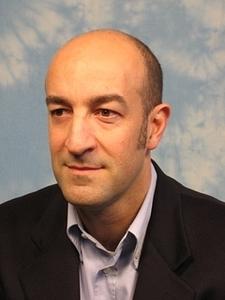
Riccardo Rattazzi

Nationality: italian

EPFL SB IPHYS LPTP
BSP 714 (Cubotron UNIL)
Rte de la Sorge
1015 Lausanne

Mission

What is the dynamics underlying electroweak symmetry breaking? Does it entail new symmetry principles, such as supersymmetry or conformal invariance? Is there a common principle underlying all fundamental interactions and why is gravity much weaker than all other forces? How can one find a clue to those question in the forthcoming data from the Large Hadron Collider? These are the basic questions driving the research of Riccardo Rattazzi.
Riccardo Rattazzi was born in Novara (Italy) in 1964. He studied physics at the University of Pisa, where he received the Laurea cum laude in 1987, and at the Scuola Normale Superiore where he received the Diploma in Scienze and carried out graduate research in theoretical physics. After having been a post-doctoral research associate at the Lawrence Berkeley Laboratory, at Rutgers University and at CERN, in 1998 Riccardo obtained a permanent research position at the Istituto Nazionale di Fisica Nucleare in Pisa. From 2001 to 2006 he was a staff member at the Theory Division of CERN. In 2006 he was appointed professor of physics at EPFL.

Teaching & PhD

PhD Students

Filippo Nardi, Javier Reig Navarro, Ian Ishaan Le Meur, Vincenzo Vittorio Pulvirenti

Past EPFL PhD Students

Jan Dalibor Mrazek, Alessandro Vichi, Duccio Pappadopulo, Andrea Thamm, Lorenzo Vitale, Davide Greco, Bernardo Zan, Kin Mimouni, Gabriel Francisco Cuomo, Gil Badel, Alfredo Glioti, Eren Clément Firat

Courses

Quantum field theory I

PHYS-431

The goal of the course is to introduce relativistic quantum field theory as the conceptual and mathematical framework describing fundamental interactions.

Quantum field theory II

PHYS-432

The goal of the course is to introduce relativistic quantum field theory as the conceptual and mathematical framework describing fundamental interactions such as Quantum Electrodynamics.

Quantum field theory III

PHYS-503

The course builds on QFT1-2 and develops in parallel to The Standard Model course. After briefly revisiting the notions of particle, field and S-matrix, the course fully develops the theory of Renormalization and closes on the quantization of non-abelian gauge theories.