
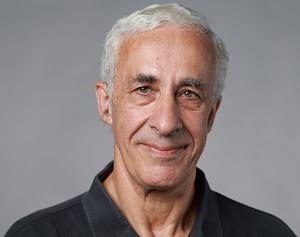
Pascal Fua
EPFL IC IINFCOM CVLAB
BC 310 (Bâtiment BC)
Station 14
1015 Lausanne
+41 21 693 66 47
Office:
BC 310
EPFL › IC › IINFCOM › CVLAB
Website: https://cvlab.epfl.ch/
+41 21 693 66 47
Office:
BC 310
EPFL › IC › IC-SIN › SIN-ENS
Website: https://sin.epfl.ch
+41 21 693 66 47
Office:
BC 310
EPFL › IC › IC-SSC › SSC-ENS
Website: https://ssc.epfl.ch
Expertise
His research interests include shape modeling and motion recovery from images, analysis of microscopy images, and machine learning. He has (co)authored over 400 publications in refereed journals and conferences. He has received several ERC grants. He is an IEEE Fellow and has been an Associate Editor of IEEE journal Transactions for Pattern Analysis and Machine Intelligence. He often serves as program committee member, area chair, and program chair of major vision conferences and has co-founded three spinoff companies.
Awards
AIAA Award for Best Scientific Paper
American Institute of Aeronautics and Astronautics
2024
Koenderink Prize,, Online, 2020.
European Conference on Computer Vision
2020
Selected publications
DeepGeo: Deep Geometric Mapping for Automated and Effective Parameterization in Aerodynamic Shape Optimization
Pascal Fua
Published in American Institute of Aeronautics and Astronautics in 2025
SLIC Superpixels Compared to State-of-the-art Superpixel Methods
R. Achanta, A. Shaj, K. Smith, A. Lucchi, P. Fua, and S. S�sstrunk.
Published in IEEE Transactions on Pattern Analysis and Machine Intelligence, vol. 34, num. 11, p. 2274 - 2282, 2012. in
Multicamera People Tracking with a Probabilistic Occupancy Map
F Fleuret, J Berclaz, R Lengagne, and P Fua
Published in Pattern Analysis and Machine Intelligence, 30 (2), 267-282, 2008 in
Keypoint Recognition using Randomized Trees
V. Lepetit and P. Fua
Published in Transactions on Pattern Analysis and Machine Intelligence, Vol. 28, Nr. 9, pp. 1465--1479, 2006. in
Object-Centered Surface Reconstruction: Combining Multi-Image Stereo and Shading
P. Fua and Y. G. Leclerc
Published in International Journal of Computer Vision, Vol. 16, pp. 35-56, 1995. in
A Parallel Stereo Algorithm that Produces Dense Depth Maps and Preserves Image Features
P. Fua
Published in Machine Vision and Applications, Vol. 6, Nr. 1, pp. 35-49, 1993. in
All since 1996
Teaching & PhD
PhD Students
Daniele Affinita, Yihong Chen, Zhantao Deng, Edouard Robert Albert Patrick Dufour, Corentin Dumery, Aoxiang Fan, Saqib Javed, Deniz Sayin Mercadier, Emilien David Luc Seiler, Federico Stella, Nicolas Talabot, Yingxuan You, Hantao Zhang, Tianzong Zhang
Past EPFL PhD Students
Karim Ali (2012), Timur Bagautdinov (2018), Pierre Bruno Baqué (2018), Carlos Joaquin Becker (2016), Jan Bednarík (2022), Horesh Beny Ben Shitrit (2014), Jérôme Berclaz (2010), Róger Bermúdez Chacón (2020), Deblina Bhattacharjee (2023), Michael Calonder (2010), Alberto Crivellaro (2016), Miodrag Dimitrijevic (2007), Andrea Fossati (2010), Przemyslaw Rafal Glowacki (2016), Germán González Serrano (2011), Benoît Guillard (2023), Semih Günel (2022), Shuxuan Guo (2022), Lorna Herda (2003), David Honzátko (2024), Slobodan Ilic (2005), Isinsu Katircioglu (2022), Sena Kiciroglu (2023), Ksenia Konyushkova (2019), Pascal Lagger (2009), Krzysztof Maciej Lis (2023), Weizhe Liu (2021), Aurélien Lucchi (2013), Andrii Maksai (2019), Agata Justyna Mosinska (2019), Krishna Kanth Nakka (2022), Tien Dat Ngo (2016), Doruk Oner (2023), Mustafa Özuysal (2010), Julien Pilet (2008), Ralf Plänkers (2001), Edoardo Remelli (2022), Roberto Rigamonti (2014), Artem Rozantsev (2017), Mathieu Salzmann (2009), Seyed Ali Shahrokni (2005), Amos Sironi (2016), Xiaolu Sun (2015), Bugra Tekin (2018), Engin Tola (2010), Tomasz Trzcinski (2014), Engin Türetken (2013), Michal Jan Tyszkiewicz (2024), Raquel Urtasun (2006), Luca Vacchetti (2004), Aydin Varol (2012), Vidit Vidit (2023), Xinchao Wang (2015), Zhen Wei (2026), Pamuditha Udaranga Wickramasinghe (2022), Kaicheng Yu (2021)
Courses
Computer vision
CS-442
Computer Vision aims at modeling the world from digital images acquired using video or infrared cameras, and other imaging sensors. We will focus on images acquired using digital cameras. We will introduce basic processing techniques and discuss their field of applicability.
Introduction to machine learning
CS-233
Machine learning and data analysis are becoming increasingly central in many sciences and applications. In this course, fundamental principles and methods of machine learning will be introduced, analyzed and practically implemented.